The ASME thickness formulas for 2:1 elliptical, torispherical, hemispherical and flat heads, and the depth of each head type for working out the tank's height.
Why does the head type matter?
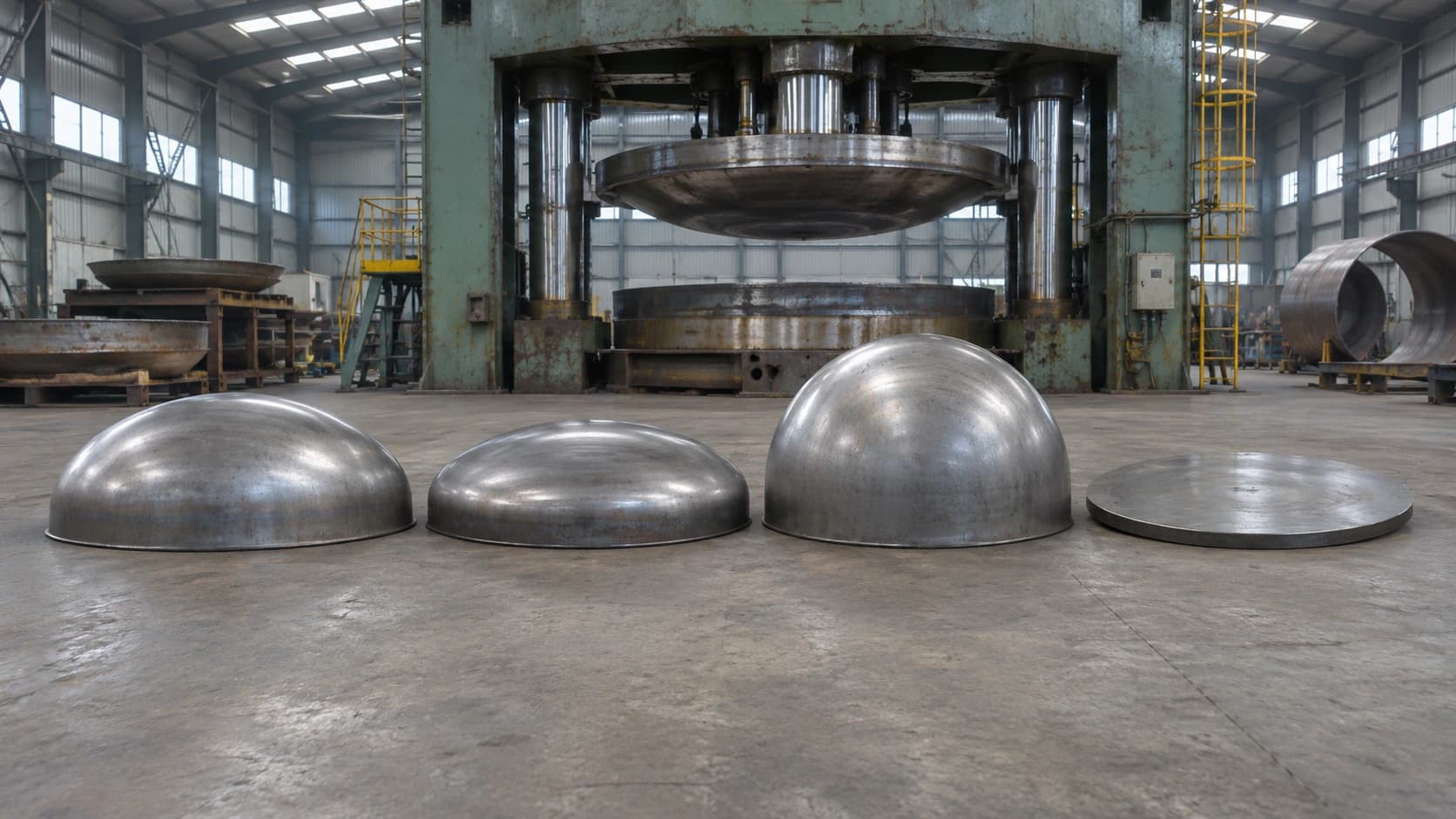
The closer a head is to a sphere, the better it spreads stress and the thinner it can be. But it also gets deeper and harder to make. The choice between the two depends on pressure, diameter and price. Tank heads are usually made on dishing and flanging machines.
Head thickness formulas to ASME Section VIII Div.1
| Head type | Thickness formula (internal pressure) | Note |
|---|---|---|
| 2:1 elliptical | t = P·D / (2·S·E − 0.2·P) | About the same thickness as the shell |
| Torispherical (L = D, r = 6% D) | t = 0.885·P·L / (S·E − 0.1·P) | Slightly thicker than elliptical |
| Hemispherical | t = P·L / (2·S·E − 0.2·P) | About half the shell thickness |
| Flat | t = d·√(C·P / S·E) | Much thicker; only for low pressure or small diameter |
In these formulas P is the design pressure, D the inside diameter, L the crown radius, S the plate's allowable stress, E the joint efficiency and C the attachment factor of the flat head. The corrosion allowance is added to the result. The raw plate thickness must also be a little greater, because the plate thins during forming, especially in the knuckle area.
Head depth for calculating tank height
| Head type | Approximate depth (without straight flange) |
|---|---|
| 2:1 elliptical | 0.25 × diameter |
| Korbbogen (DIN 28013) | About 0.255 × diameter |
| Klöpper (DIN 28011) | About 0.194 × diameter |
| ASME torispherical (6%) | About 0.17 × diameter |
| Hemispherical | 0.5 × diameter |
The straight flange is added to the head depth. It is usually a few tens of millimetres and moves the head-to-shell weld away from the knuckle area.
Blank diameter
The blank diameter comes from the developed surface of the head plus the straight flange and a trimming allowance. The relation differs for each head type. The calculator on the heads page works out the thickness, depth, weight and blank diameter together for any diameter and type.
For normal pressures, the 2:1 elliptical head strikes a good balance between thickness and fabrication cost. Torispherical is shallower and cheaper, and hemispherical is for high pressures or very large diameters.