Floating roof storage tank
For volatile petroleum products and lower evaporation losses
A floating roof tank is designed to store volatile petroleum products such as gasoline and light naphtha that evaporate readily. In these tanks the roof floats directly on the liquid surface, and by reducing the vapour space between roof and liquid it cuts evaporation losses and environmental emissions considerably.
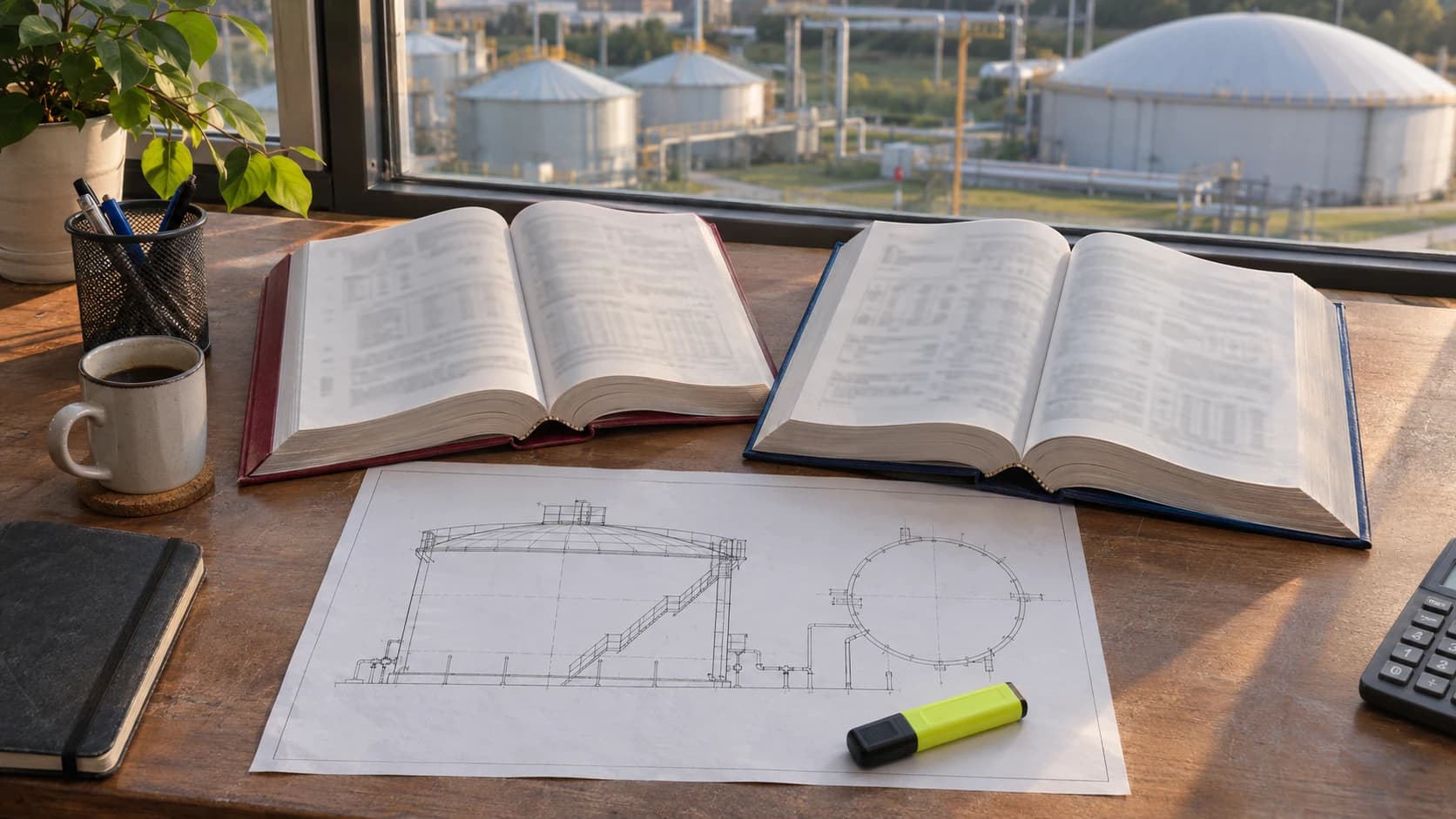
Designing a floating roof tank includes choosing the roof type (external floating, or internal floating under a fixed roof), designing the rim seal system to stop vapour escaping, the roof support legs for when the tank is empty, and the drainage system for rainwater on the roof.
Behineh Ab designs and builds floating roof tanks to the principles of API 650, taking into account the product, the storage capacity and the project's safety requirements.
- Why is a floating roof used for volatile products?
- Because the roof sits directly on the liquid surface, the vapour space is minimised and evaporation losses and fire risk drop noticeably.
- What is the difference between an external and an internal floating roof?
- An external floating roof is open to the air, while an internal floating roof sits under a fixed roof and is better protected from the weather.
- What does the floating roof seal system do?
- It seals the gap between the roof edge and the tank shell so product vapour cannot escape.
- Is it suitable for all petroleum products?
- Floating roof tanks are mainly recommended for volatile products with a high vapour pressure; for heavier products a fixed-roof tank is usually enough.