Design and fabrication of
galvanized tanks
A complete guide to fabrication, hot-dip galvanizing, coating quality control and water-industry applications
A galvanized tank is a steel tank that, once fabricated, is dipped in a bath of molten zinc at about 450 °C. The zinc works like a coat of paint that keeps water and air away from the steel, and if it gets scratched, the zinc corrodes in place of the steel. The result is a tank that lasts 25 to 50 years, depending on its environment.
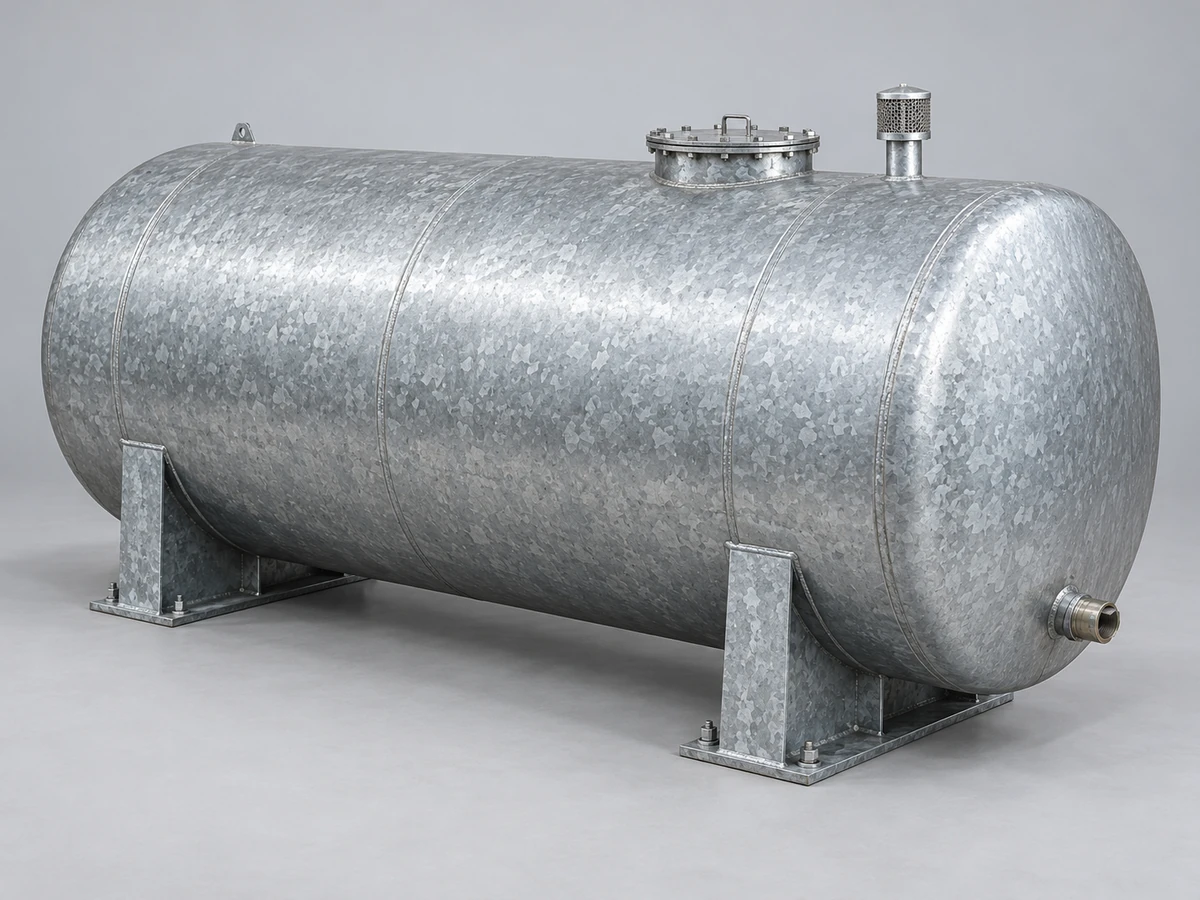
Galvanized tank fabrication
Fabrication, hot-dip galvanizing and coating quality control
A galvanized tank is built in one of two ways. In the first, the tank is fully welded and then galvanized, so its size is limited by the dimensions of the bath. In the second, the panels are galvanized separately and bolted together on site. In both cases coating thickness is checked against ISO 1461 and ASTM A123.
The most common use is the galvanized water tank: drinking water, fire water, agriculture and elevated tanks on towers. Its price reflects both the weight of steel and the cost of galvanizing. Below we explain the steps of galvanized tank fabrication, quality control, and the advantages and limitations.
2. Galvanizing basics and protection
After surface preparation, the part is immersed in molten zinc at about 440–460 °C. The iron–zinc reaction forms Fe-Zn alloy layers bonded to the steel, topped by an outer layer of pure zinc.
Barrier: the zinc layer stops moisture and oxygen from reaching the steel. Sacrificial/cathodic: zinc is more active than iron, so at a local scratch the zinc corrodes instead of the steel. This is its main advantage over paint.
3. Raw materials and steel plate
Silicon and phosphorus content strongly change the thickness and appearance of the coating.
| Parameter | Preferred range | Effect on coating |
|---|---|---|
| Silicon (Si) | < 0.04% or 0.15–0.25% | Outside these ranges: thick, grey, brittle coating |
| Phosphorus (P) | < 0.02% | Higher → excessive coating growth |
| Plate grade | St37 / S235JR | The most common grade for water tanks |
| Plate thickness | 2–6 mm (by volume) | Strength and pressure capacity |
4. Full fabrication steps
Dimensions, volume, pressure, nozzles and a cutting plan. Cutting by guillotine, plasma/laser/CNC or oxy-fuel, then deburring. Forming by rolling, press brake, and pressing or spinning for the heads. Bolted panels are ribbed for structural stiffness.
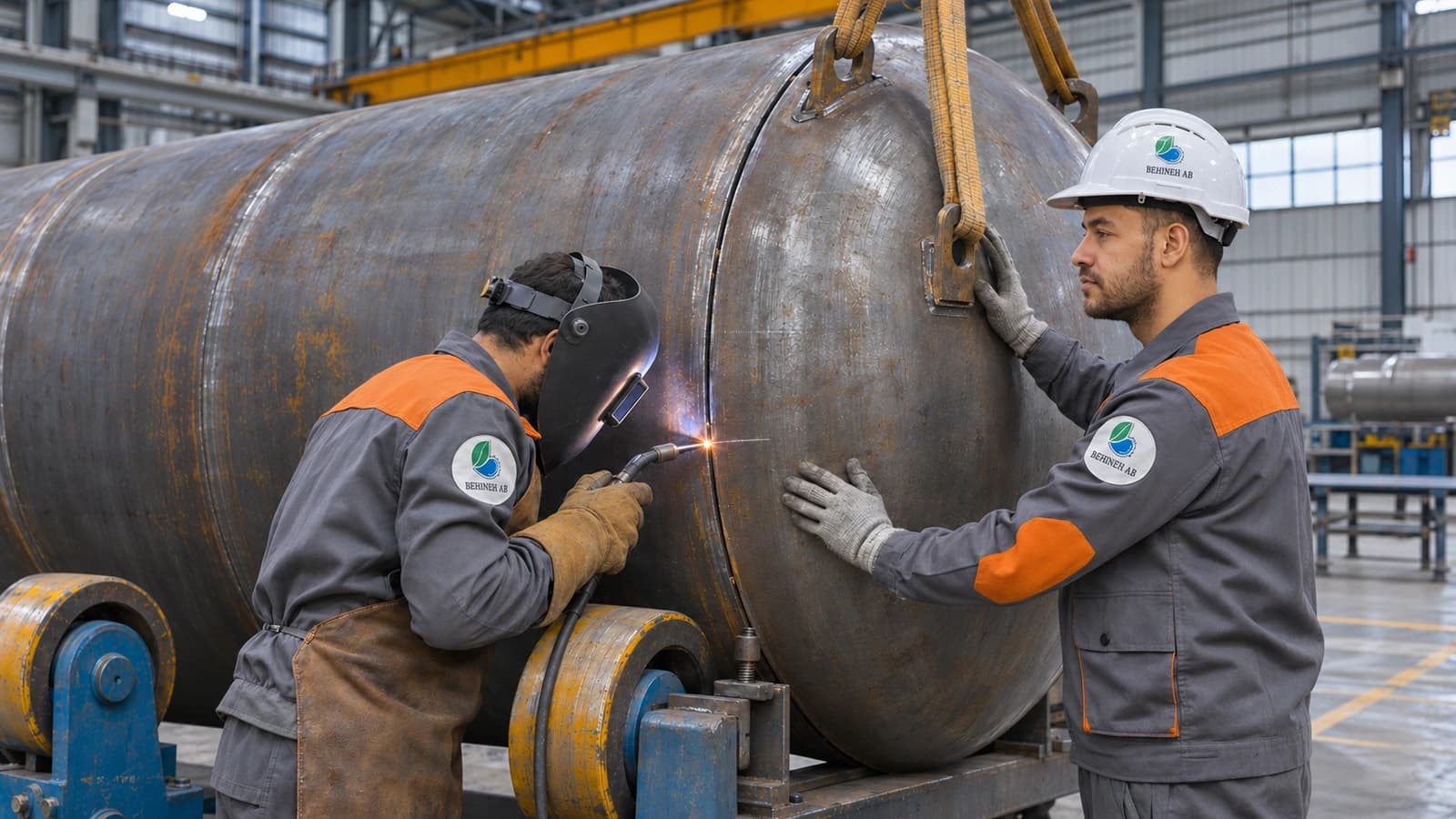
On a welded tank, all welding must be done before galvanizing; welding on a galvanized surface melts the coating and releases zinc fumes. MIG/MAG, SMAW or TIG. Seams must let molten zinc flow in; trapped air pockets risk an explosion in the bath. Vent and drain holes per ISO 1461. All slag and spatter removed.
5. The hot-dip galvanizing process
1) Alkaline or acid degreasing. 2) Pickling in HCl or H₂SO₄ to remove mill scale. 3) Rinsing. 4) Fluxing in zinc ammonium chloride. 5) Drying. 6) Immersion in the bath at 440–460 °C. 7) Quenching/cooling, sometimes with passivation against white rust. 8) Inspection of thickness, uniformity, adhesion and appearance.
7.1. Coating thickness (ISO 1461)
Minimum mean and local zinc coating thickness by base-steel thickness (approximate, ISO 1461):
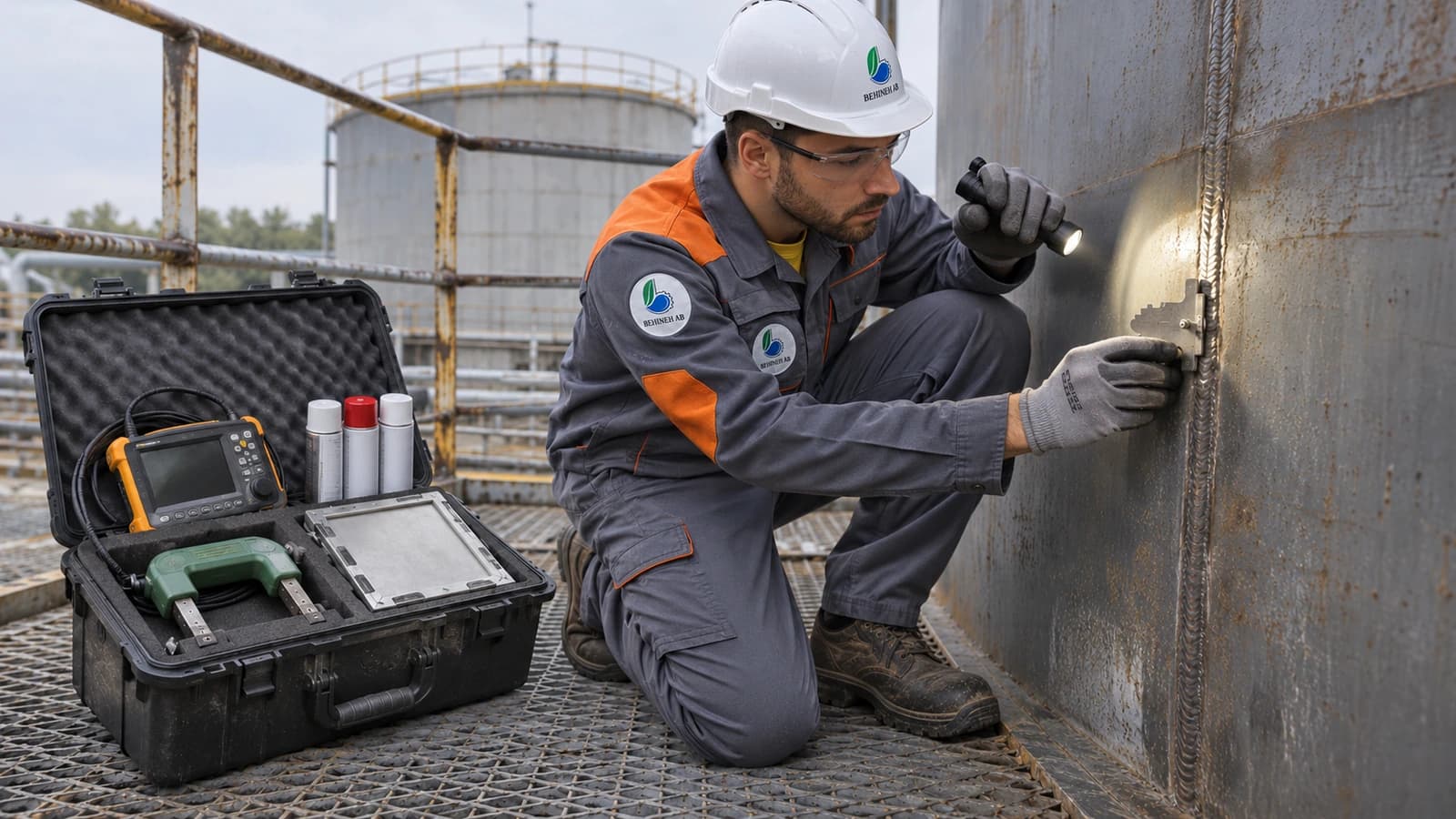
Steel 1.5 to < 3 mm: mean 55 μm (395 g/m²), local 45 μm. Steel < 1.5 mm: mean 45 μm (325 g/m²), local 35 μm. Measured with a magnetic thickness gauge. ASTM A123 and ISO 1461 are largely equivalent on thickness; the choice depends on the target market and the client.
6. Bolted tanks
Each panel is galvanized on its own and bolted together on site, so no welding heat ever touches the coating. Sealing is done with neoprene or polyurethane gaskets and sealant.
| Feature | Welded | Bolted |
|---|---|---|
| When galvanized | Welded before galvanizing | Assembled after galvanizing |
| Coating integrity | Weld areas need local repair | Coating fully intact |
| Transport | One bulky piece | Flat panels, easy |
| Site installation | Harder | Fast, no site welding |
| Capacity | Small to medium | Medium to very large |
| Sealing | Welds fully watertight | Depends on gasket quality |
7. Coating quality control
Knife test: the coating must not flake. Bend test: no cracking or separation. Hammer test: controlled blows must not cause peeling.
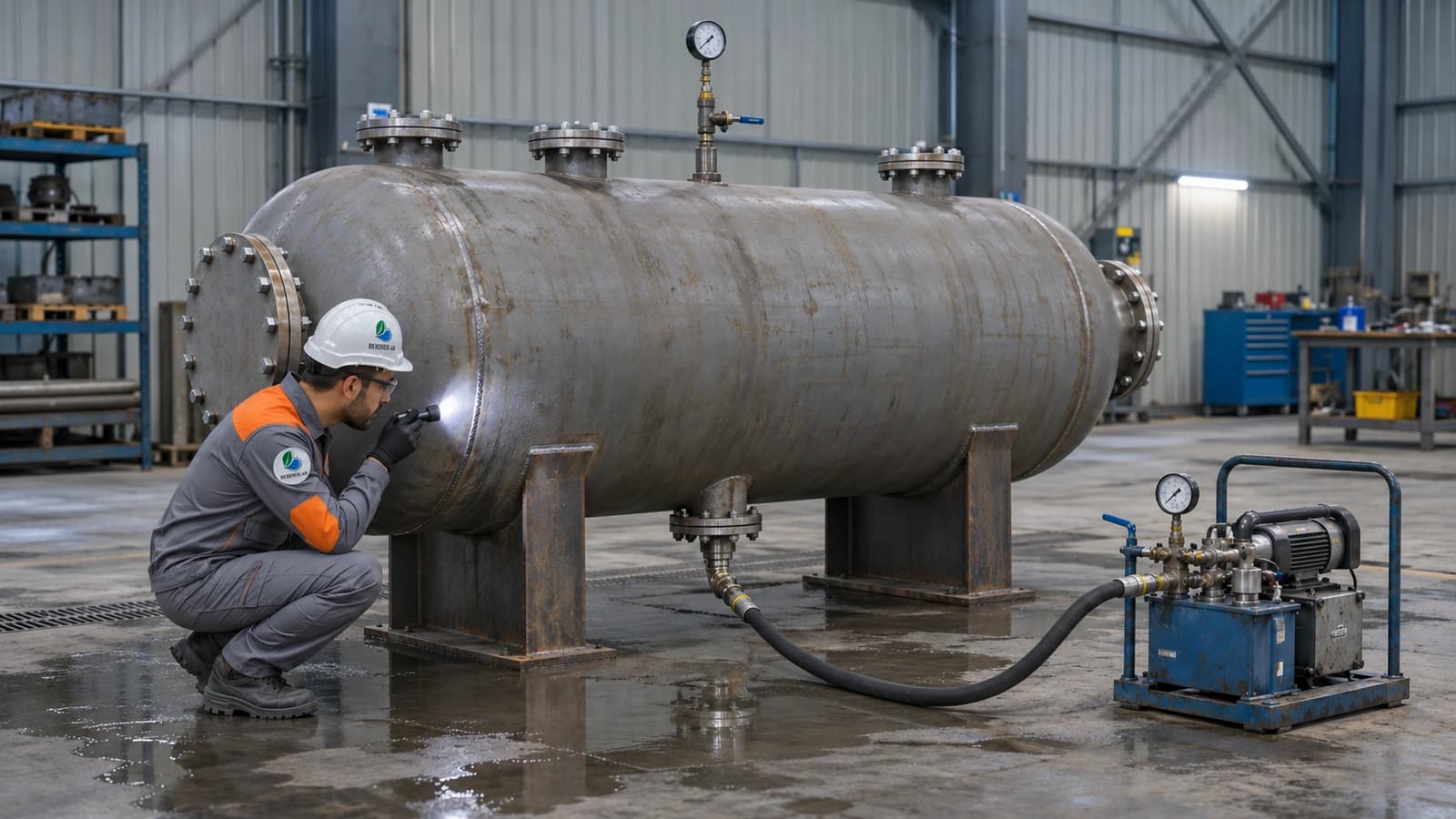
Appearance free of zinc drips, ash inclusions, bare spots and excessive roughness. Coating continuity. Checks for distortion caused by the thermal shock of the bath.
8 & 9. Advantages and limitations
Corrosion resistance and a 25–50 year life. Sacrificial protection at damaged spots. Low maintenance with no periodic repainting. Full coverage of seams and corners. Fast installation when bolted. Zinc and steel are both recyclable. The alloy layers are harder than the base steel and resist abrasion well.
Part size is limited by the bath; otherwise double dipping or panels. Large thin plates can distort. No welding after galvanizing — repairs use zinc-rich paint. Rapid corrosion at pH < 6 or pH > 12. White rust in damp storage. For drinking water, zinc leaching must be checked and an internal lining added if needed.
10. Uses in the water industry
Municipal, rural and building drinking-water storage. Fire-water tanks (often high-capacity bolted). Agricultural and greenhouse irrigation. Water and wastewater treatment plants. Industrial and refinery cooling water. Elevated and ground tanks for water networks.
11. Summary and Behineh Ab services
Building a galvanized tank combines steel engineering, a controlled hot-dip process and continuous coating QC. Following ASTM A123 and ISO 1461, choosing the right base steel, designing seams and vent holes, and choosing between welded and bolted construction all decide how long the tank lasts.
Behineh Ab Engineering offers consulting, design, fabrication and installation of galvanized tanks for water, fire-protection, agricultural and industrial projects, matching international standards to each project's local and budget constraints.
Technical specifications
Welded or bolted?
A tank welded before galvanizing has the integrity of welded seams, but its size is limited by the zinc bath. A bolted tank keeps its coating untouched, ships as flat panels and reaches larger capacities, but its tightness depends on the quality of the gaskets.
Why no welding after galvanizing?
Welding heat melts and vaporizes the zinc, destroys the protection and gives off toxic fumes. The weld area then has to be repaired with zinc-rich paint, which never matches the original hot-dip coating.
Applications and industries
Photo gallery
Galvanized tank gallery
Frequently asked questions
Request a quote
Galvanized tank fabrication
Enter the pressure, temperature and fluid; our engineers send a technical proposal and price within 24 working hours.
- Written technical reply with a proposed concept drawing
- Site visit in Tehran and surroundings
- 24-month warranty on fabrication and welding