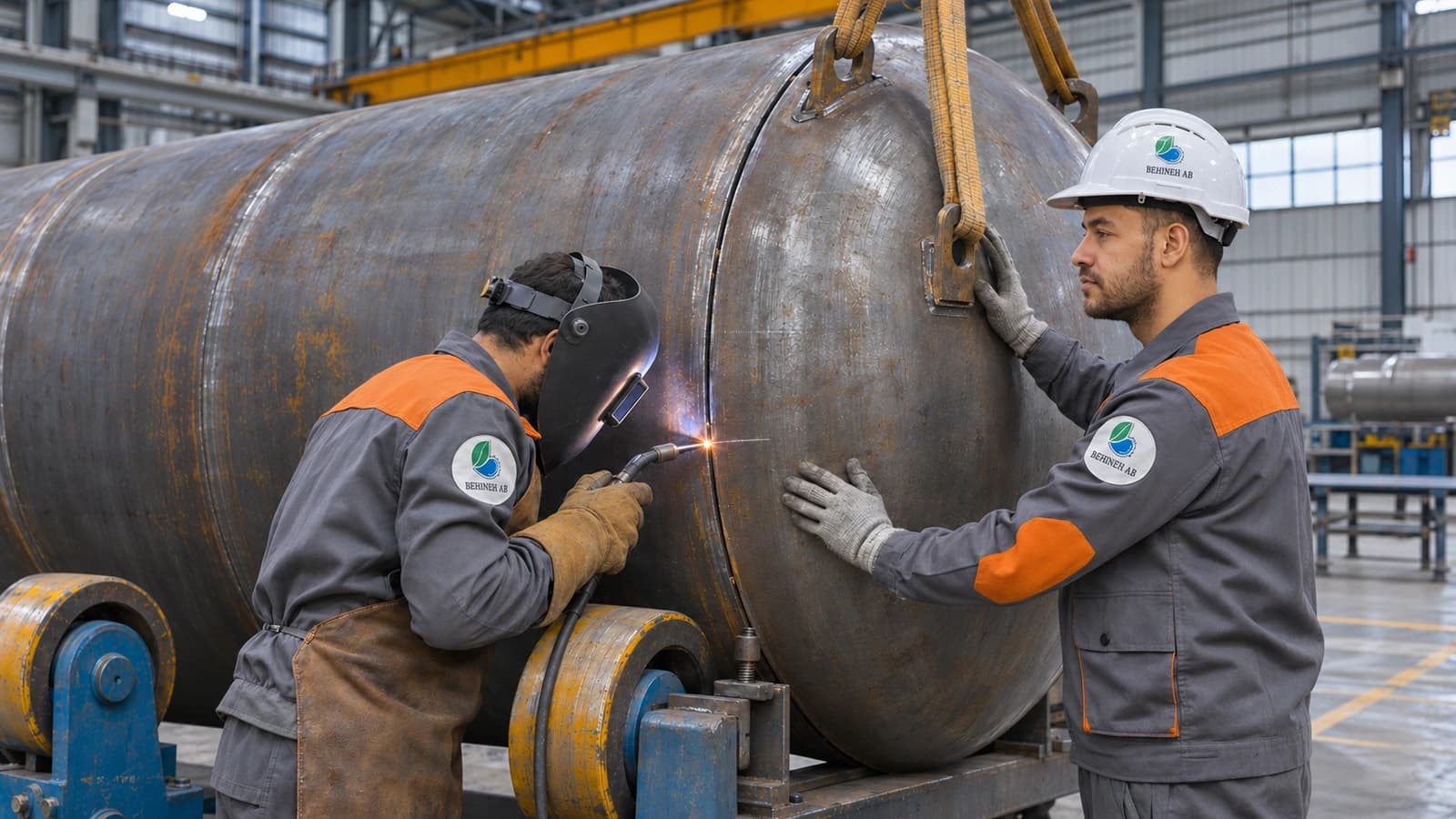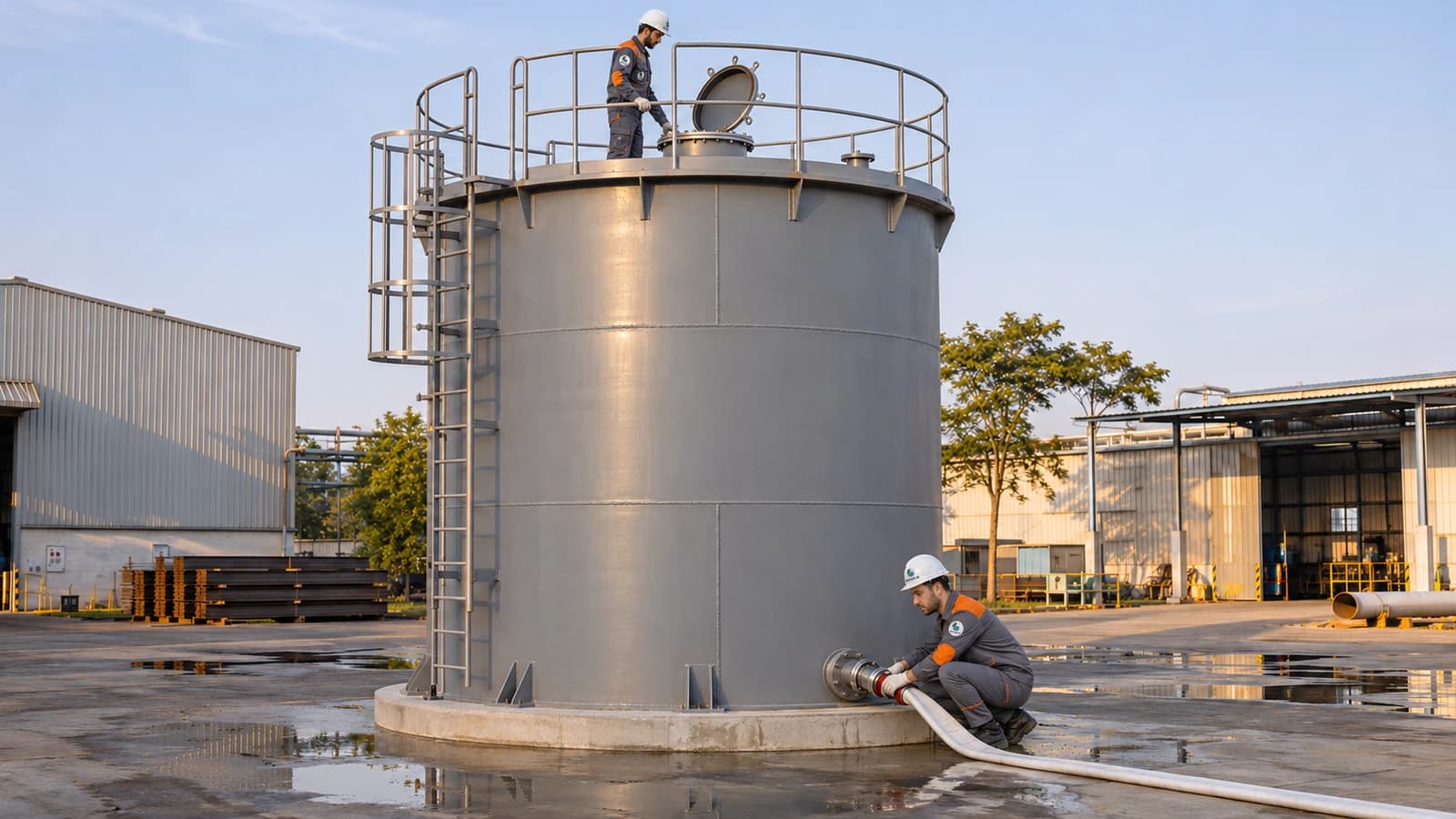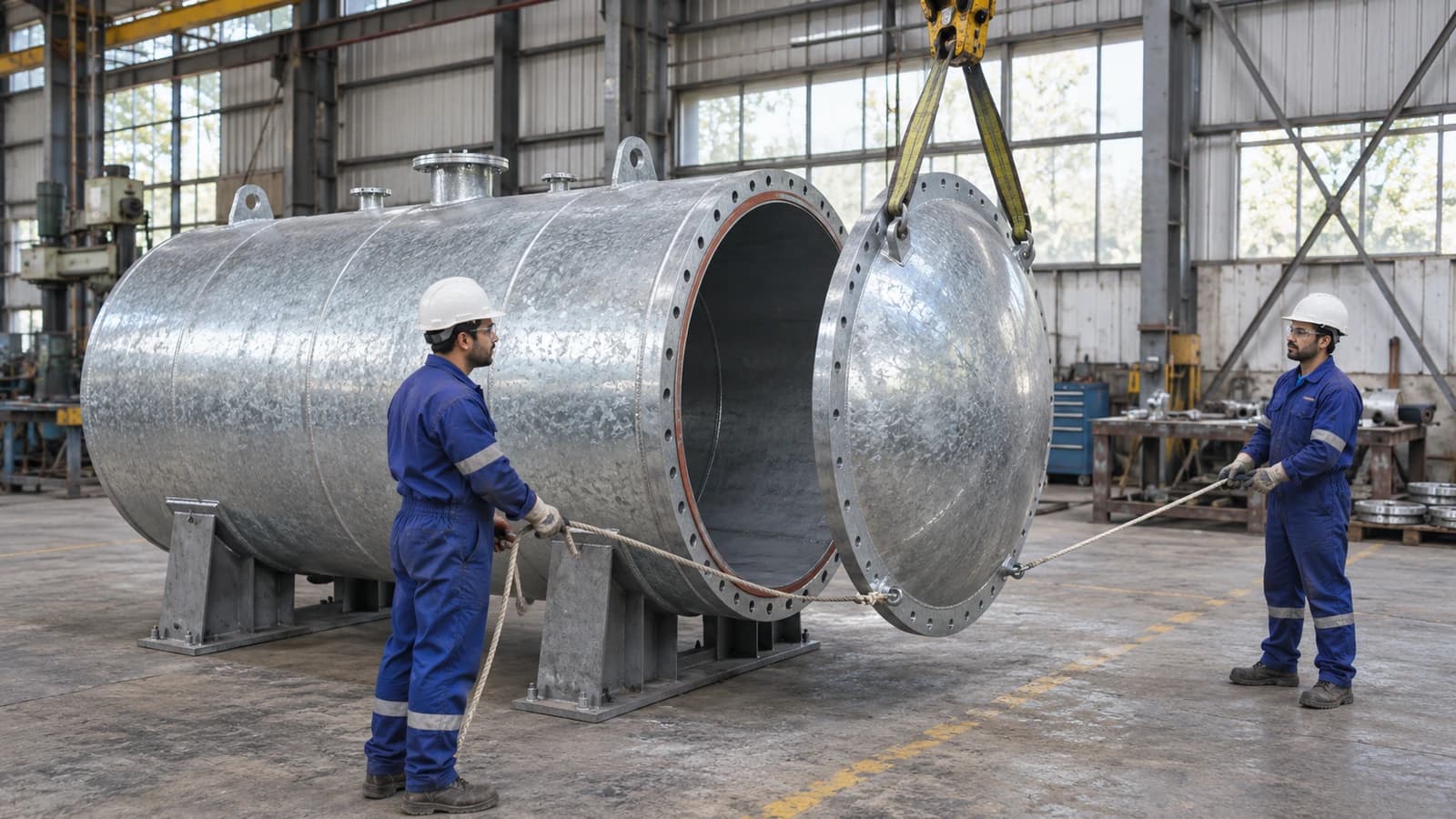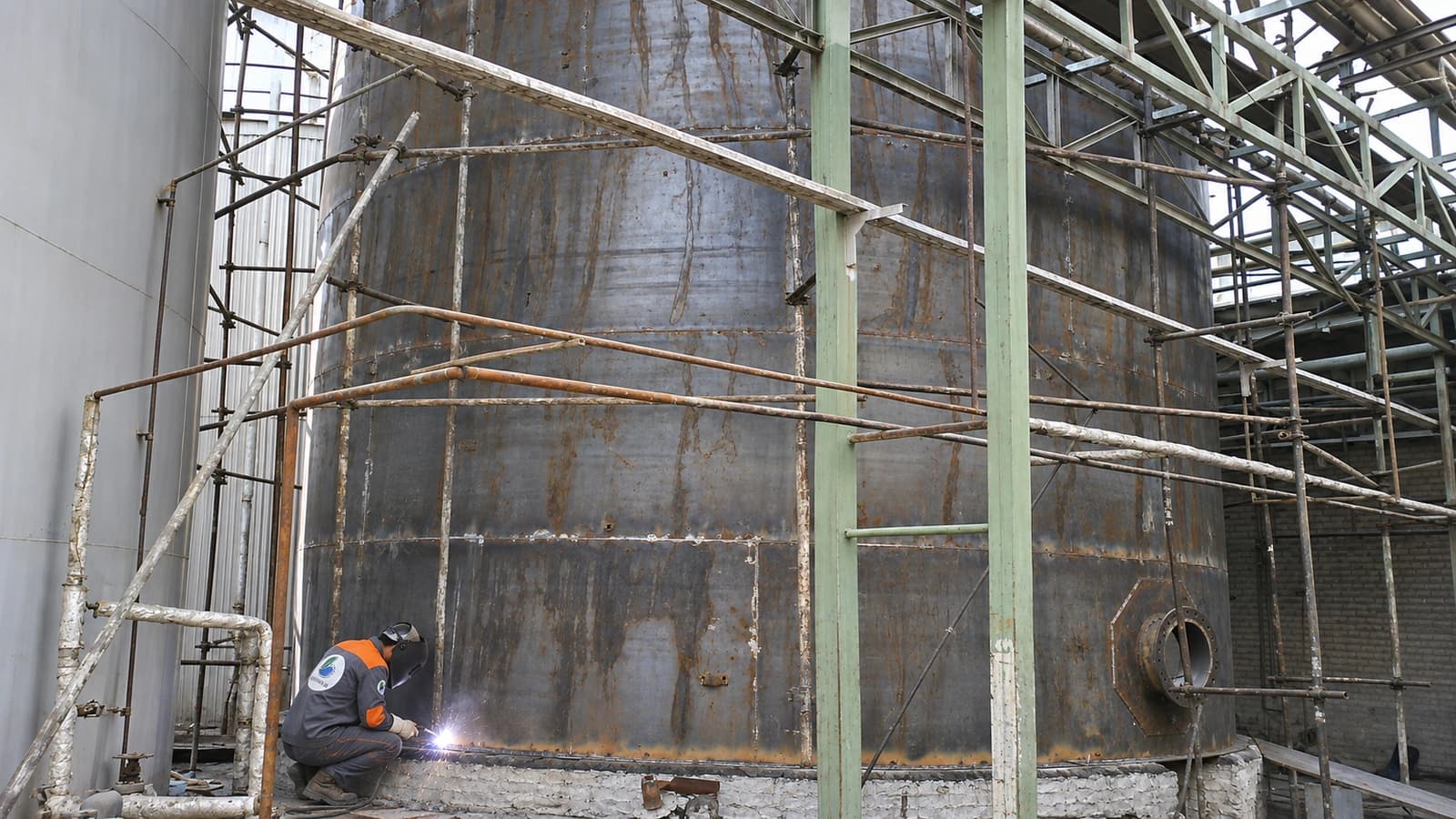
A large oil tank is built at the project site. The construction steps from the foundation and bottom plates to erecting the shell, a fixed or floating roof, and the hydrotest with settlement monitoring.
Why are oil tanks built on site?
Storage tanks for crude oil and products are usually several thousand to several tens of thousands of cubic metres, and their diameter exceeds any road transport limit. So the plates are cut and rolled in the factory and the tank is built at the project site. The design is to API 650, and to estimate the dimensions and course thicknesses you can use the online API 650 tank calculator.
1. Foundation
An oil tank usually sits on a concrete ring (ringwall) with a compacted sand bed inside it. The bed surface slopes slightly outward or toward the centre so that water and sediment drain away. The ringwall level must be accurate: any unevenness here later shows itself as a tilted shell and a floating roof that sticks.
2. Bottom plates
The bottom plates are lap-welded (overlapping edge on edge), and all around the bottom there is a ring of thicker plate, called the annular plate, that sits under the shell. Because the bottom plate welds cannot be seen from below, they are checked with a vacuum box test.
3. Erecting the shell: from the bottom or with jacks
| Method | How it works | Advantage |
|---|---|---|
| Conventional (bottom up) | The first course on the bottom, then the higher courses with scaffolding and a crane | Simple, suitable for very large tanks |
| Jacking (top down) | The top course and the roof are built at ground level and jacks lift the tank course by course | Most welding close to the ground; safer and faster |
The vertical and horizontal shell seams are full-penetration welds. API 650 requires a specific number of spot radiographs based on the number and length of seams and the plate thickness. The plumbness and roundness of the shell are also checked after each course.
4. Fixed or floating roof
For crude oil and volatile products such as gasoline, a floating roof tank is common. The roof floats on the liquid surface and the vapour space is practically eliminated, so evaporation, losses and fire risk are reduced. For diesel, fuel oil and bitumen, a tank with a fixed cone or dome roof is usually enough.
5. Hydrotest and settlement monitoring
The tank is filled with water up to the maximum design level. Filling is done in stages, and at each stage the elevation of several points around the tank is measured. Uniform settlement is normal, but uneven settlement means a foundation problem, and filling must stop. In a floating roof tank, the roof's movement up and down is also checked during filling.
6. Painting and safety accessories
After the test, the tank is painted and the safety accessories are installed: the earthing system, the foam fire-fighting system, the spiral stairway, the hatches and the level gauge. A bund wall is also built around the tank so that oil does not spread in the event of a leak.
In oil tank construction, the foundation and the bottom have the greatest effect on the tank's life, even though they are the least visible. Follow up the quality of these two steps more closely than the rest.