Methods of building spherical tanks: pressed petals, hydraulic forming of a polyhedron and explosive forming. Where each method is used and where it is not.
Why a sphere?
For a given volume and pressure, a sphere has the smallest surface area and the smallest thickness. The stress is the same at every point, and the required thickness is about half that of a cylinder of the same diameter. That is why spherical tanks are common for storing liquefied gas and pressurised gases in large volumes. The hard part is fabrication, because the plate has to be curved in two directions.
The common method: pressed petals
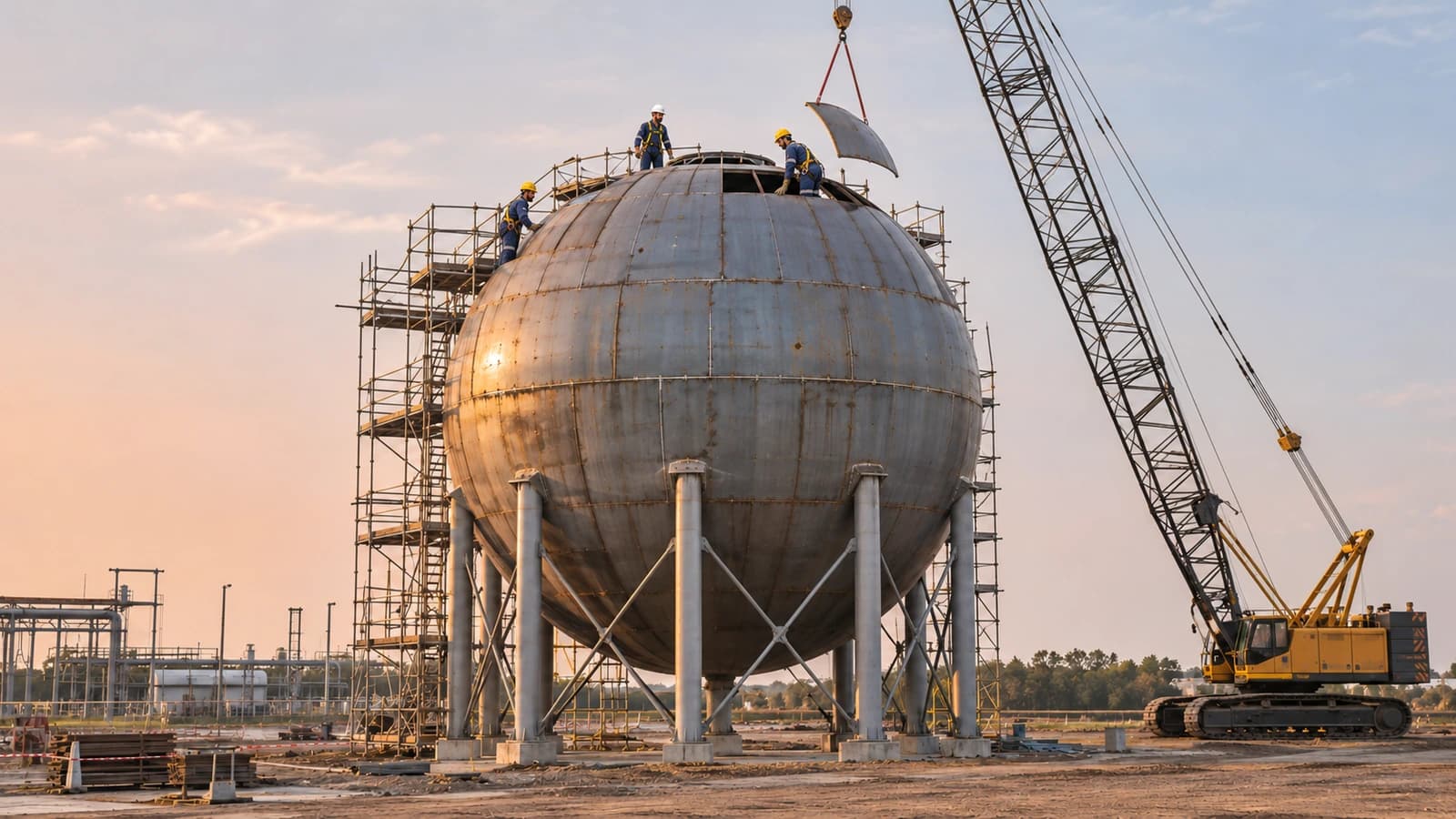
In the common method, the sphere is divided into a large number of petal-shaped pieces. Each petal is pressed separately in a die to a double curvature. The petals are assembled and welded on site on the legs. The dimensional accuracy of each piece decides how round the sphere ends up and how well the seams fit.
Explosive and hydraulic forming
In explosive forming, the plate or piece is placed on a die under water, and the blast wave forces it into the shape of the die. This method has been used for special parts, large heads and hard-to-form alloys. But it is not a common method for building complete large industrial spherical tanks, because controlling the dimensions and the plate's properties after the blast is difficult.
Another method that is sometimes confused with "building a spherical tank with explosives" is hydraulic forming. A closed polyhedron is welded from flat plates, filled with water, and the water pressure inflates it until it approaches a sphere. This method has been used for small spheres and non-process applications such as decorative structures and water tanks.
Spherical pressure vessels and the design code
A spherical tank for pressurised gas must be built, inspected and hydrotested to ASME Section VIII. With unusual methods, proving that the plate still has the required thickness and properties after forming is difficult and costly. That is why almost all industrial spherical tanks are built with the petal method. To estimate thickness and weight, see the online spherical tank calculator.
Explosive forming is a real method, but for special parts. Industrial spherical tanks are almost always built from pressed petals.