A fibreglass tank is light and resists acid, but temperature, pressure and UV limit it. A comparison with carbon steel and stainless tanks, and how a composite tank is built.
How is a fibreglass tank built?
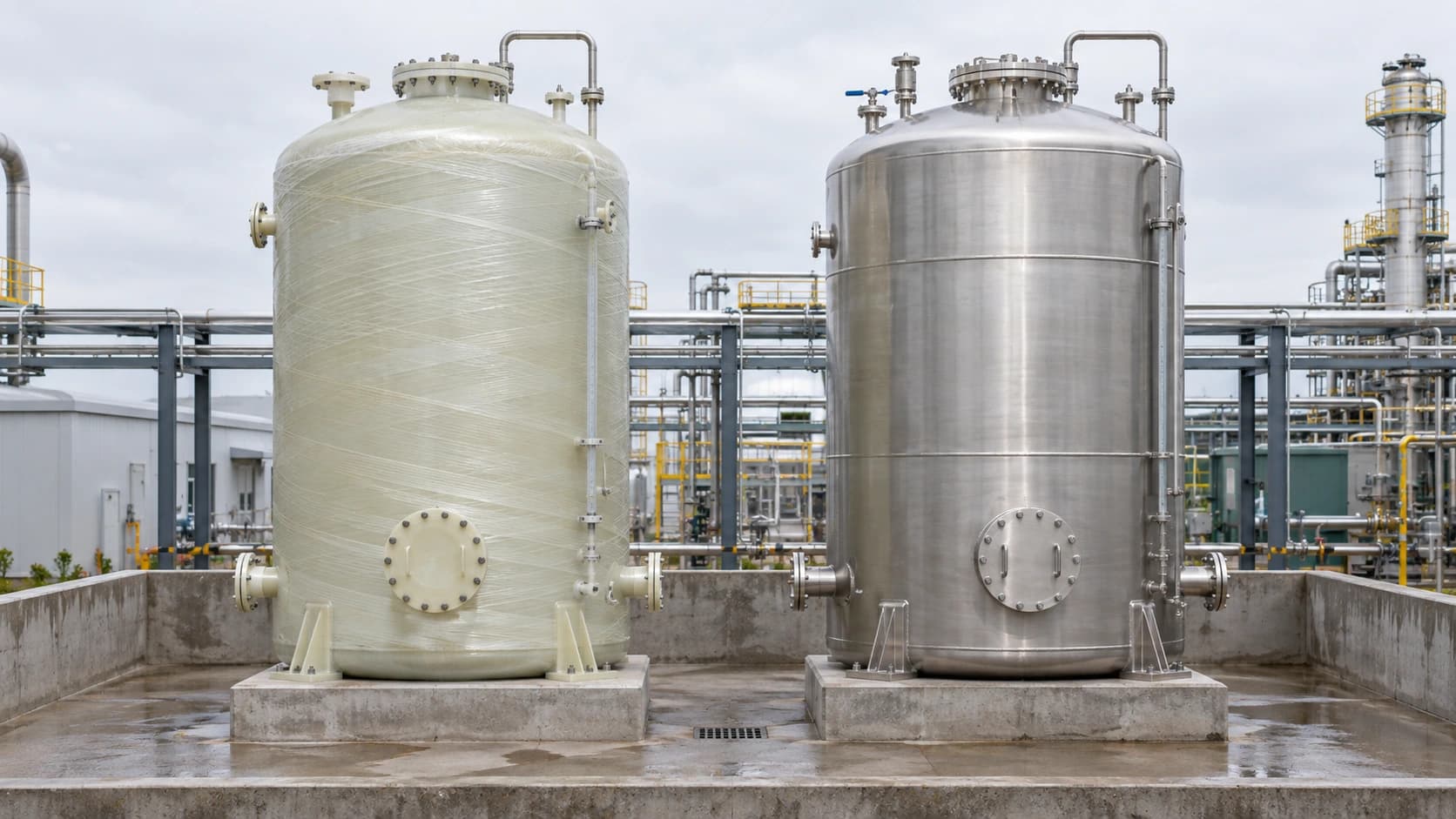
A fibreglass tank (FRP or GRP) is made from glass fibres and resin. The most common way to build a composite tank is filament winding: resin-impregnated fibres are wound around a cylindrical mandrel. More complex parts are made by hand lay-up. The innermost layer is the chemical-resistant layer in contact with the fluid, and its resin, for example vinyl ester or isophthalic polyester, is chosen to suit the fluid.
Comparison
| Criterion | Fibreglass / composite | Carbon steel and stainless |
|---|---|---|
| Chemical corrosion | Excellent for many acids and salts | Carbon steel needs a coating; stainless depends on the fluid |
| Temperature | Limited; usually below about 100 degrees | High |
| Pressure | Usually atmospheric or low pressure | From atmospheric to very high pressures |
| Weight | Light | Heavier |
| Sunlight | Degrades without a protective layer | No problem |
| Impact and fire | Sensitive | Resistant |
| Repair | Specialised and limited | Welding and plate replacement |
Which one, when?
For storing dilute acids, brine and wastewater at ambient temperature, fibreglass is a good option. If the temperature is high, there is pressure, the tank must be fire-resistant or the fluid contains solvents that attack the resin, a steel tank is the better choice. For some acids, such as concentrated sulphuric acid, a properly designed carbon steel tank is the industry standard.
A stainless tank takes the place of fibreglass in many chemical and food applications, and temperature and pressure do not limit it. For drinking water both are used, provided they are certified for contact with potable water.
Fibreglass is a good answer to corrosion at ambient temperature and low pressure. Wherever temperature, pressure, fire or impact are a factor, a steel tank is safer.