Fire water storage tank fabrication
Behineh Ab Engineering · to NFPA 22
A fire water tank is a reliable water reserve for sprinklers, hydrants, standpipes and foam systems when the municipal network cannot provide enough flow and pressure. Its design follows the strict requirements of NFPA 22 and differs fundamentally from an ordinary water tank.
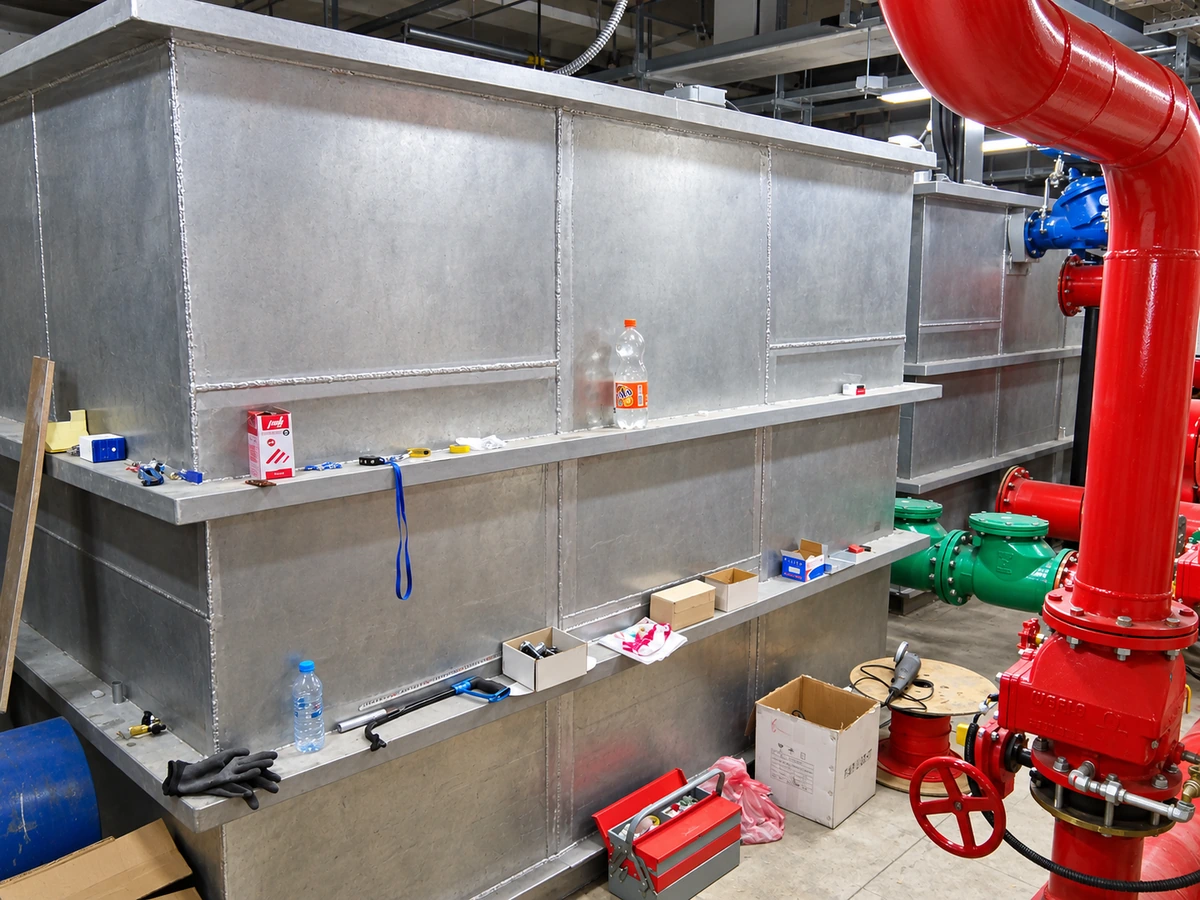
Fire water storage tank fabrication
Behineh Ab Engineering · NFPA 22
The fire water tank is the beating heart of any fire-suppression system. When the municipal water network cannot supply the flow and pressure that automatic fire-suppression systems need, it is this tank that guarantees a reliable, stable, ready-to-use water reserve at the moment of crisis.
Unlike ordinary water tanks, the design and fabrication of a fire water tank follow strict requirements, the most important of which are set out in NFPA 22. In this article, Behineh Ab Engineering covers the technical requirements, volume calculation, materials, pump-house connection, anti-corrosion coatings, and the inspection and approval process in full.
1. What is a fire water tank?
A dedicated tank for storing water for fire-suppression systems: sprinklers, hydrants, standpipes and foam. NFPA 22 applies to above-ground, elevated and buried tanks for private fire protection, and its aim is to ensure water is always available.
Under NFPA 22, the net usable capacity is the volume of water between the overflow lip and the bottom of the anti-vortex plate. Water remaining below the plate is 'dead water' and is ignored in fire-fighting calculations.
2. Requirements of NFPA 22
NFPA 22, the 'Standard for Water Tanks for Private Fire Protection', is the reference for design, construction, installation and maintenance. Periodic maintenance is covered by NFPA 25.
Installed where exposure to fire hazard is lowest, with safe setback distances from neighbouring structures.
Resistance to wind, earthquake and snow. Under IBC and ASCE 7, fire-water storage facilities are Risk Category IV (the same as hospitals and emergency centres) and carry higher seismic and wind importance factors.
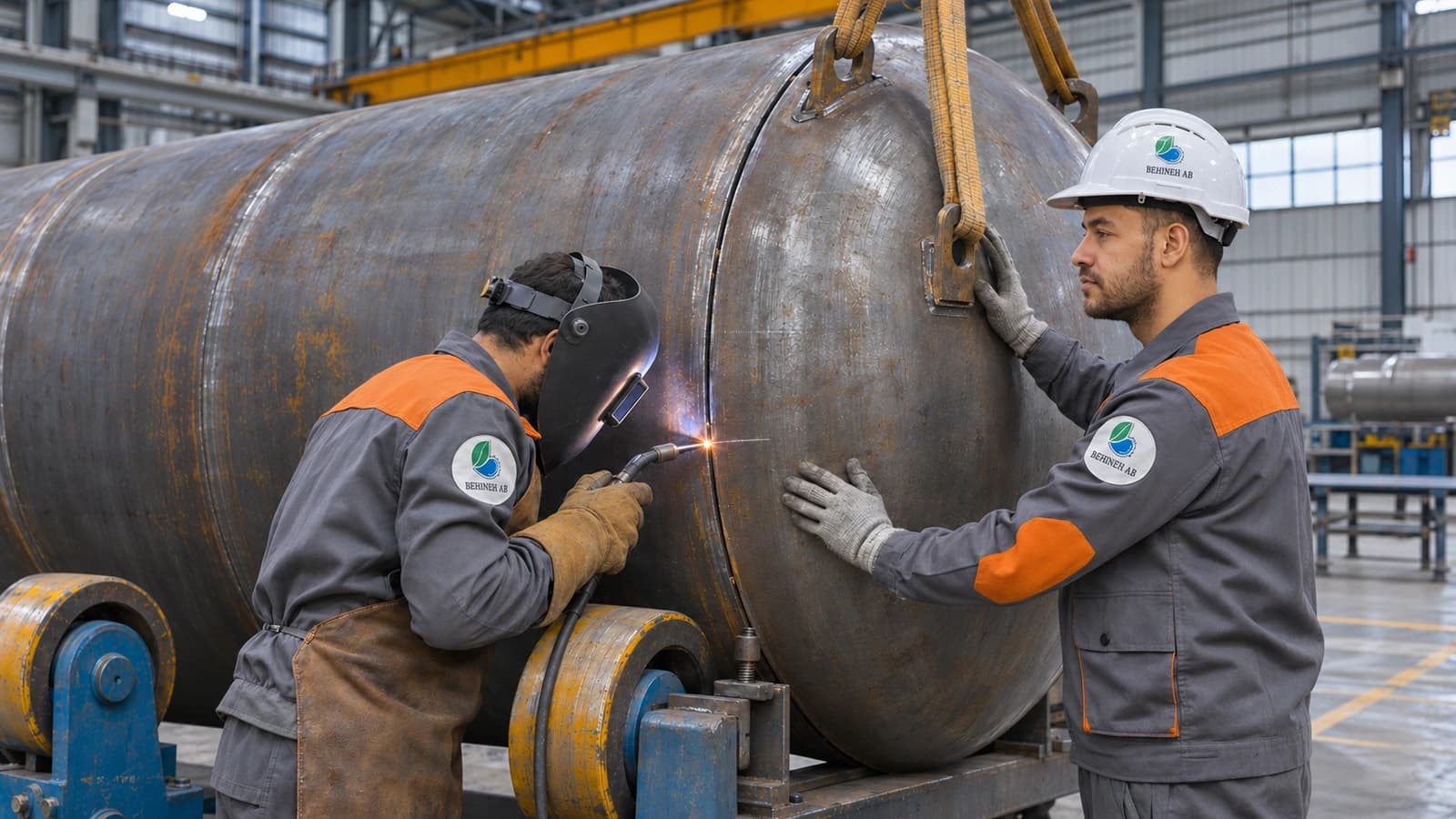
Welding to ASME Section IX, AWWA D100 and NFPA 241 to keep seams intact under environmental stresses.
Anti-vortex plate: diameter at least twice the outlet pipe and at least 15 cm (6 in) above the floor. Proper venting above the fill line with a corrosion-resistant screen to prevent vacuum and collapse. Heating in cold regions (average below −15 °C) to keep the water at least 4.4 °C. Level indicator, overflow, inspection hatch and standard fittings.
Sections 1-4 and 1-7 leave the door open to new products and technologies; final approval rests with the AHJ.
3. Calculating the required volume
Usable volume = flow × duration; then a buffer and the dead water below the anti-vortex plate are added:
The guide-table values are preliminary only. Final calculations must be based on hydraulic calculations and approval by the authority having jurisdiction (AHJ). Usable volume lies between the overflow lip and the bottom of the anti-vortex plate; the water below the vortex plate is considered 'dead'.
3. Volume calculation steps
NFPA 22 does not prescribe a fixed size; volume and height follow from the flow, pressure and duration of the fire-suppression system.
1) NFPA 13 hazard class (light / ordinary / extra). 2) Sprinkler flow from density/area. 3) Add hose stream (usually about 500 GPM for light/ordinary and up to 1,000 for extra hazard). 4) Duration of 30, 60, 90 or 120 minutes. 5) Add dead water and a buffer of about 10%.
| Hazard class | Example occupancy | Approx. flow (GPM) | Duration (min) |
|---|---|---|---|
| Light hazard | Offices, residential | 150–250 | 30–60 |
| Ordinary hazard (groups 1 & 2) | Retail, light manufacturing | 250–500 | 60–90 |
| Extra hazard / storage | Warehouses, heavy industry | 500–1,000+ | 90–120 |
Commercial sprinkler systems usually need 250–500 GPM and high-hazard ones over 1,000. Hydrants often need 1,000–2,000 GPM. In a combined system, the largest simultaneous flow or the total demand (per the code) is the basis; in high-rise buildings the standpipe usually governs.
4. Tank materials
Welded steel (AWWA D100): high industrial capacity. Bolted / glass-fused (AWWA D103): fast installation. Stainless: high corrosion resistance, higher cost. Concrete (ACI 318): buried and very large capacities. FRP: light and corrosion-resistant for small to medium capacities.
| Tank type | Main advantage | Limitation | Reference standard |
|---|---|---|---|
| Welded steel | High capacity, durable | Needs internal and external coating | AWWA D100 |
| Bolted steel | Fast factory-made installation | Needs coating/liner | AWWA D103 |
| Stainless | Naturally corrosion-resistant | High initial cost | — |
| Concrete | Long life, suits burial | Longer construction time | ACI 318 |
| FRP | Light, corrosion-resistant | Capacity limits | — |
5. Connection to the pump house
The tank's performance depends on a correct connection to the fire pump house under NFPA 20.
The suction arrangement must give the pump enough NPSH; the 2023 edition of NFPA 22 (Annex A.4.1.6) states explicitly that NPSH must be provided in line with NFPA 20.
Prevents vortexing and air entrainment (cavitation). A long-radius elbow at the outlet, no short-radius elbows, and the ability to draw 100% of the usable water down to the lowest level without the pump failing.
6. Anti-corrosion coatings
AWWA D102 for welded tanks: SSPC-SP10 preparation and internal painting; a minimum dry film of about 25 mil. AWWA D103 for bolted tanks; SSPC-SP8 pickling where permitted. FM 4020 has specific coating and liner requirements.
Lead-free coatings with at least 18 months of performance history. Internal coatings suited to immersion service and wet/dry cycling. Panels inspected before and after installation; damaged panels that cannot be repaired are replaced.
An alternative or supplement to coatings: AWWA D102 at least 25 mil; FM 4020 unreinforced at least 30 mil and scrim-reinforced at least 24 mil. A geotextile pre-liner is recommended to prevent tears.
7. Inspection, testing and approval
FM Approvals certifies property-loss prevention. FM 4020 covers steel fire-protection tanks and pump suction tanks with a zero-failure philosophy. Note: FM is a commercial body; a tank can meet the technical requirements without being formally FM Approved.
Hydraulic calculations, engineering documentation, material specifications and accessory details for approval by the authority having jurisdiction.
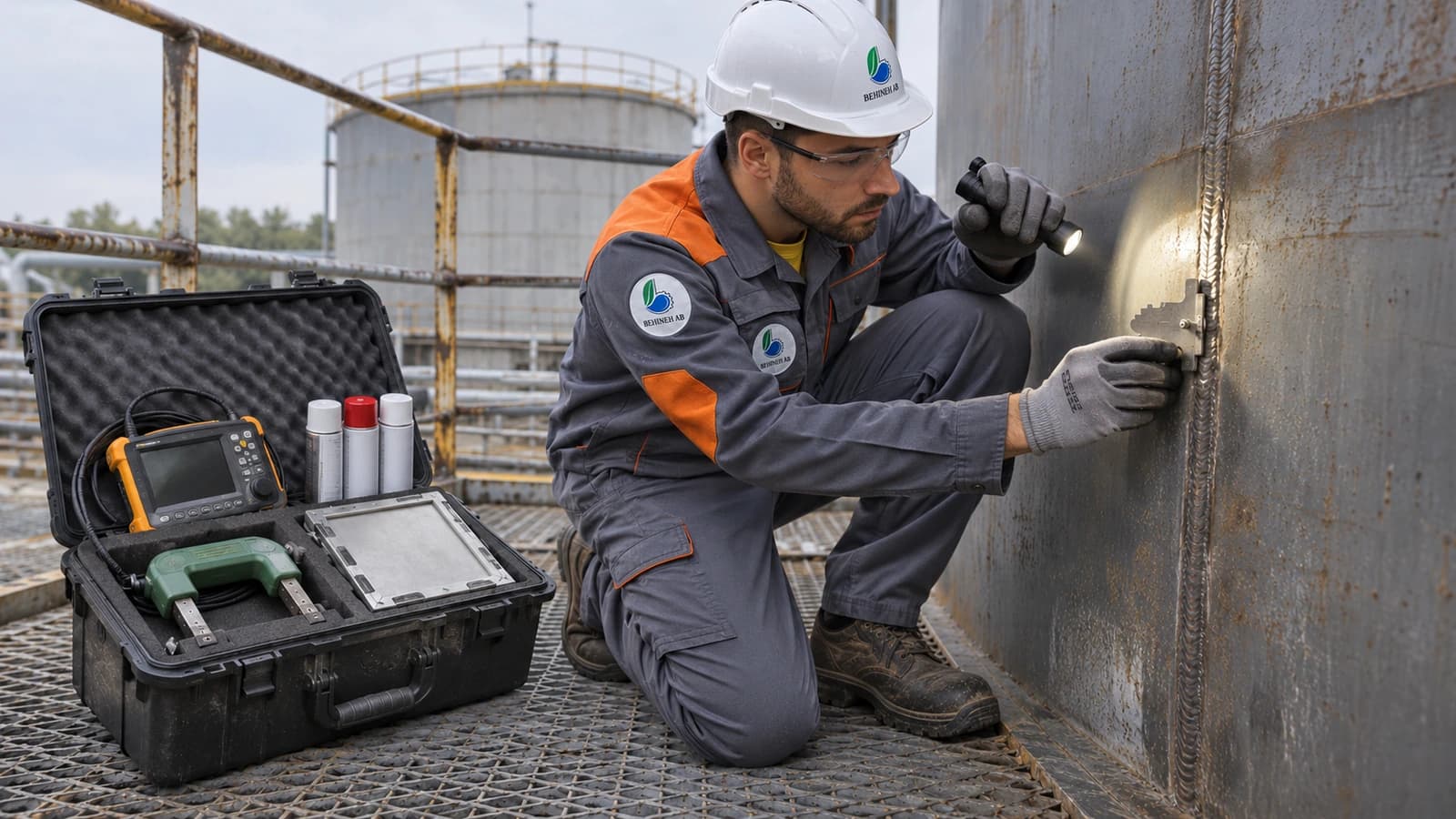
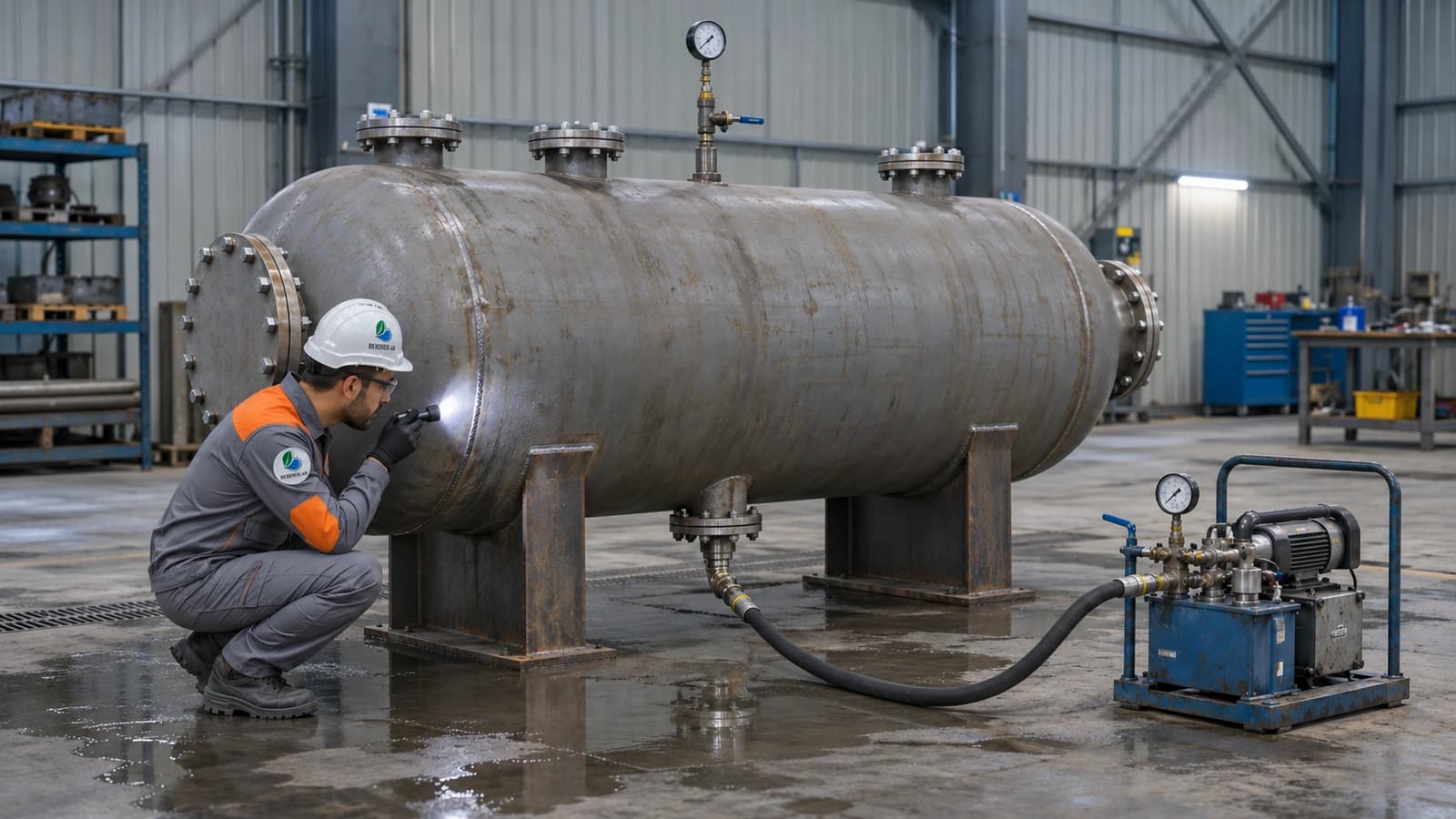
Annual inspection of water level, structure and heating. Internal inspection every 5 years for corrosion and sediment. Annual pump test at 100% and 150% of rated flow. Verification of capacity and accessories.
8. Summary and Behineh Ab services
A fire water tank is a critical safety system; the smallest error in design or construction can make the whole fire-suppression system fail in a crisis. Following NFPA 22, calculating volume from NFPA 13 and 14, choosing materials and coatings, connecting to the pump house under NFPA 20 and obtaining approvals all need a specialist engineering team.
Behineh Ab Engineering offers: design and hydraulic calculations to NFPA; fabrication in steel, stainless, concrete and FRP; standard coatings and liners; pump-house connection; and advice on approvals and inspection.
This article is for information. The final design of each project must be based on project-specific calculations and AHJ approval.
Technical specifications
Why must a fire water tank be separate from the domestic tank?
If fire water comes from the same tank the building uses every day, there may not be enough water when a fire breaks out. That is why standards such as NFPA 22 require a defined, dedicated minimum reserve for fire water that must never be drawn for other uses. Other international standards such as AWWA D103, FM 4020 and UNE 23.500 may also form the design basis, depending on the project's country.
Bladder tank vs. mastic tank
A bladder tank uses a high-density PVC inner liner that prevents leaks and microbial growth and is also suitable for drinking water. A mastic tank is sealed with a polyurethane coating and specialist sealants. The choice between them usually depends on whether drinking-water contact is needed and on the project budget.
Calculating storage volume from flow and response time
The volume of a fire water tank is the required fire-pump flow (based on the building's type and area) multiplied by the minimum required continuous operating time (usually 30 to 120 minutes depending on occupancy). This calculation must be done before the tank's final dimensions are set, not from the space available on site.
Special fittings and equipment for fire water tanks
A dedicated outlet for direct connection to the fire pump, an inspection hatch to check the tank's internal condition and, on some projects, a connection to a foam system for special fires are essential equipment that must be considered from the start of the design.
Applications and industries
Photo gallery
Fire water storage tank gallery
Frequently asked questions
Request a quote
Fire water storage tank fabrication
Enter the pressure, temperature and fluid; our engineers send a technical proposal and price within 24 working hours.
- Written technical reply with a proposed concept drawing
- Site visit in Tehran and surroundings
- 24-month warranty on fabrication and welding