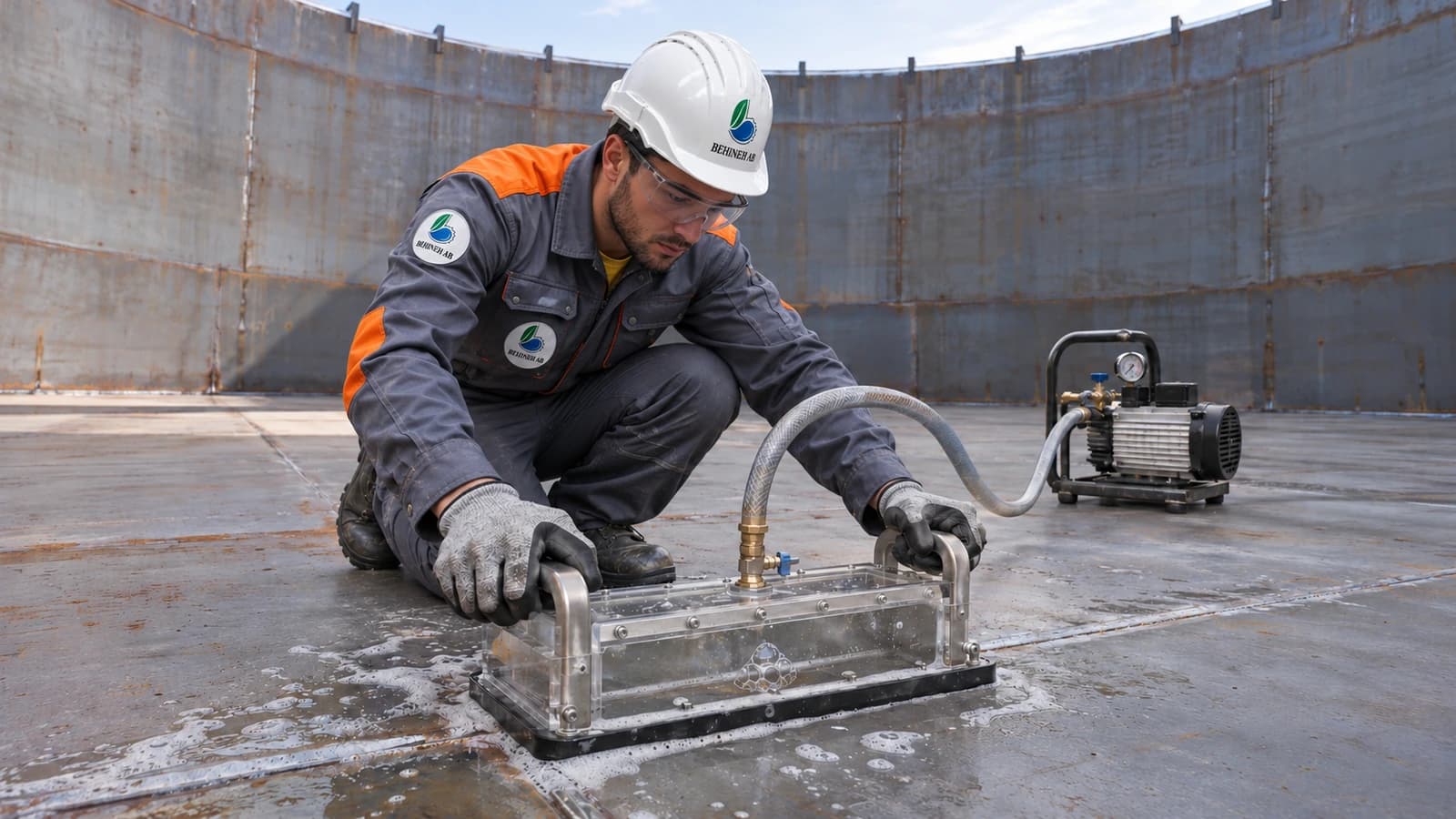
A tank bottom sits on the foundation and cannot be seen from below. The vacuum box finds leaks in the bottom plate welds from above, before filling.
Why does a tank bottom need a separate test?
In large storage tanks built on site, the bottom plates are welded on the foundation. If one of these welds leaks, it is not seen in the hydrotest either, because the water goes straight into the soil or sand bed. A bottom leak shows itself later through soil contamination and corrosion from underneath.
How it is done
- The weld is wetted with a foaming solution (soapy water)
- A box with a clear body and a rubber seal around it is placed on the weld
- A pump creates a vacuum inside the box; API 650 requires at least 21 kPa (3 psi)
- The vacuum is held for at least a few seconds while the inspector watches the weld through the window
- If bubbles appear, air has entered from under the weld and that spot leaks
- The box is moved along the next length of weld with an overlap
Each move of the box must overlap the previous section. The edge of the box is where the seal is weakest, and if two positions are placed exactly edge to edge, part of the weld is effectively not tested.
Where else is it used?
Besides the bottom, the plate welds of fixed roofs and parts of floating roofs are checked the same way. Any weld that is accessible from only one side and cannot be put under pressure is a candidate for the vacuum box.
The vacuum box is simple, cheap and accurate, provided it is done patiently and with enough overlap. In on-site construction projects, the third-party inspection company carries out this test before the hydrotest.