How a steel water tank is built, step by step: choosing the material, calculating plate thickness, the potable-water coating and the fill test. With notes on small water tanks.
Material first: carbon steel, galvanised or stainless?
How a water tank is built depends above all on its material. All three metal options hold water well. They differ in initial price, maintenance and service life.
| Material | Advantage | Limitation | Suitable for |
|---|---|---|---|
| Carbon steel with epoxy coating | The cheapest, no size limit | The internal coating must be inspected and repaired periodically | Large industrial and fire-water tanks |
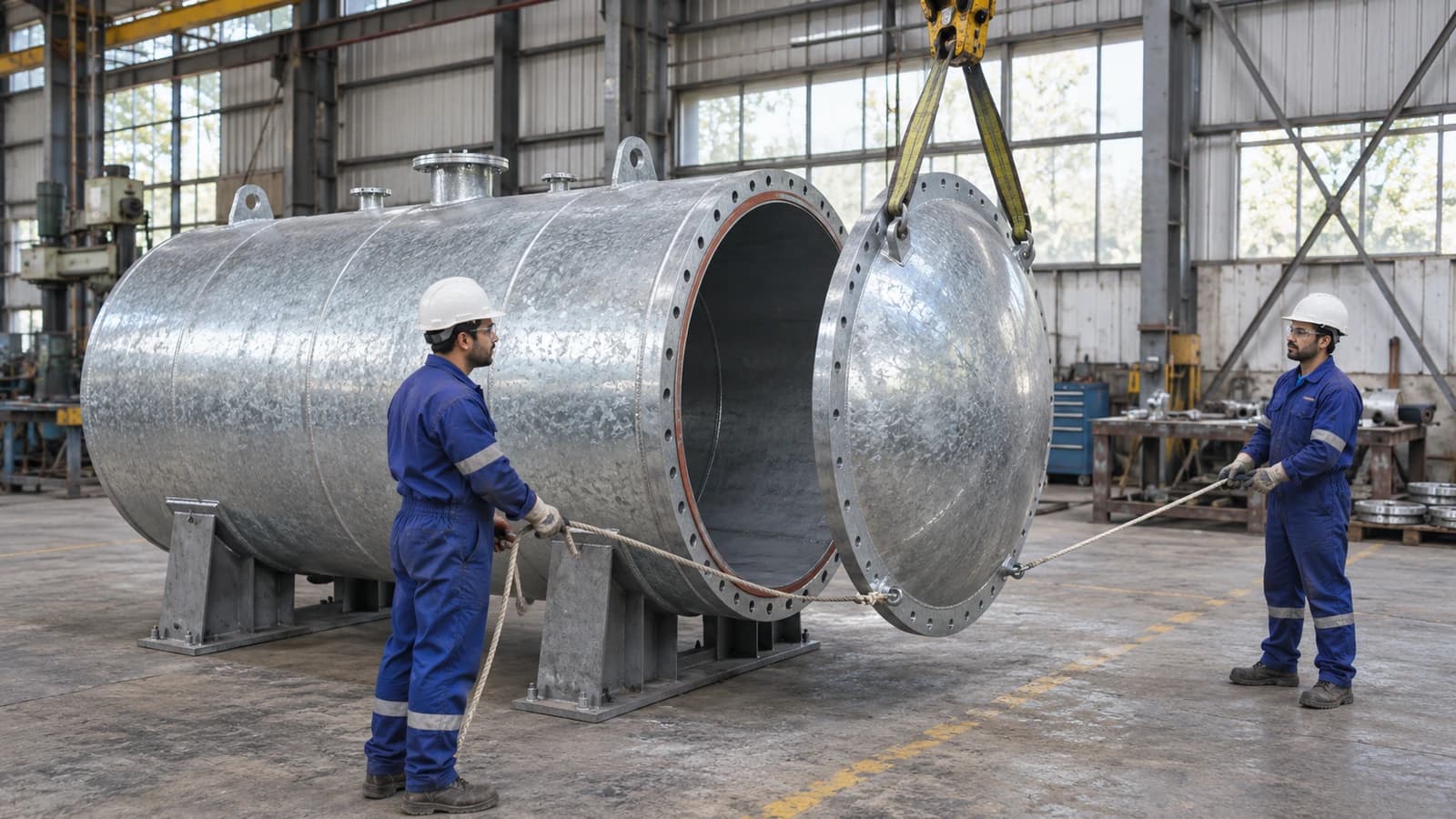
| Hot-dip galvanised | Corrosion protection without internal paint | The size of a welded tank is limited by the galvanising bath | Drinking and agricultural water, elevated tanks |
| Stainless 304 or 316 | No coating, hygienic, long life | Plate costs several times as much as carbon steel | Drinking water, RO and small water tanks |
Tank volume and shape
The volume of a drinking water tank is the daily consumption multiplied by the number of days of storage you need. A fire-water tank has its own calculation: its volume is set by fire regulations, not daily use. If you put both in one tank, the consumption outlet must sit above the fire reserve so that this volume is never drawn down.
A vertical cylindrical tank has the lowest plate weight per litre. A horizontal tank is for places where height is limited, and a rectangular tank for tight spaces such as plant rooms and rooftops. A rectangular tank has flat plates that bulge under water pressure, so it needs stiffeners and is heavier per litre than a cylindrical tank.
How is water tank plate thickness calculated?
Water pressure is highest at the bottom of the tank and depends on the height of the water column, not the volume. For atmospheric storage tanks, API 650 calculates the thickness of each shell course with the one-foot method: thickness equals 4.9 times the diameter (m) times the water height minus 0.3 m, times the specific gravity, divided by the plate's allowable stress (MPa), plus the corrosion allowance.
For a 20,000-litre tank 2.5 m in diameter and 4.1 m high, this formula gives less than half a millimetre of thickness. But API 650 requires a minimum fabrication thickness of 5 mm for tanks under 15 m in diameter. So in small and medium water tanks the minimum fabrication thickness governs, and in large tanks the water pressure does.
To see this calculation for your own dimensions, use the online water tank calculator. It shows the thickness of each course, the weight and the optimum dimensions.
Fabrication and welding
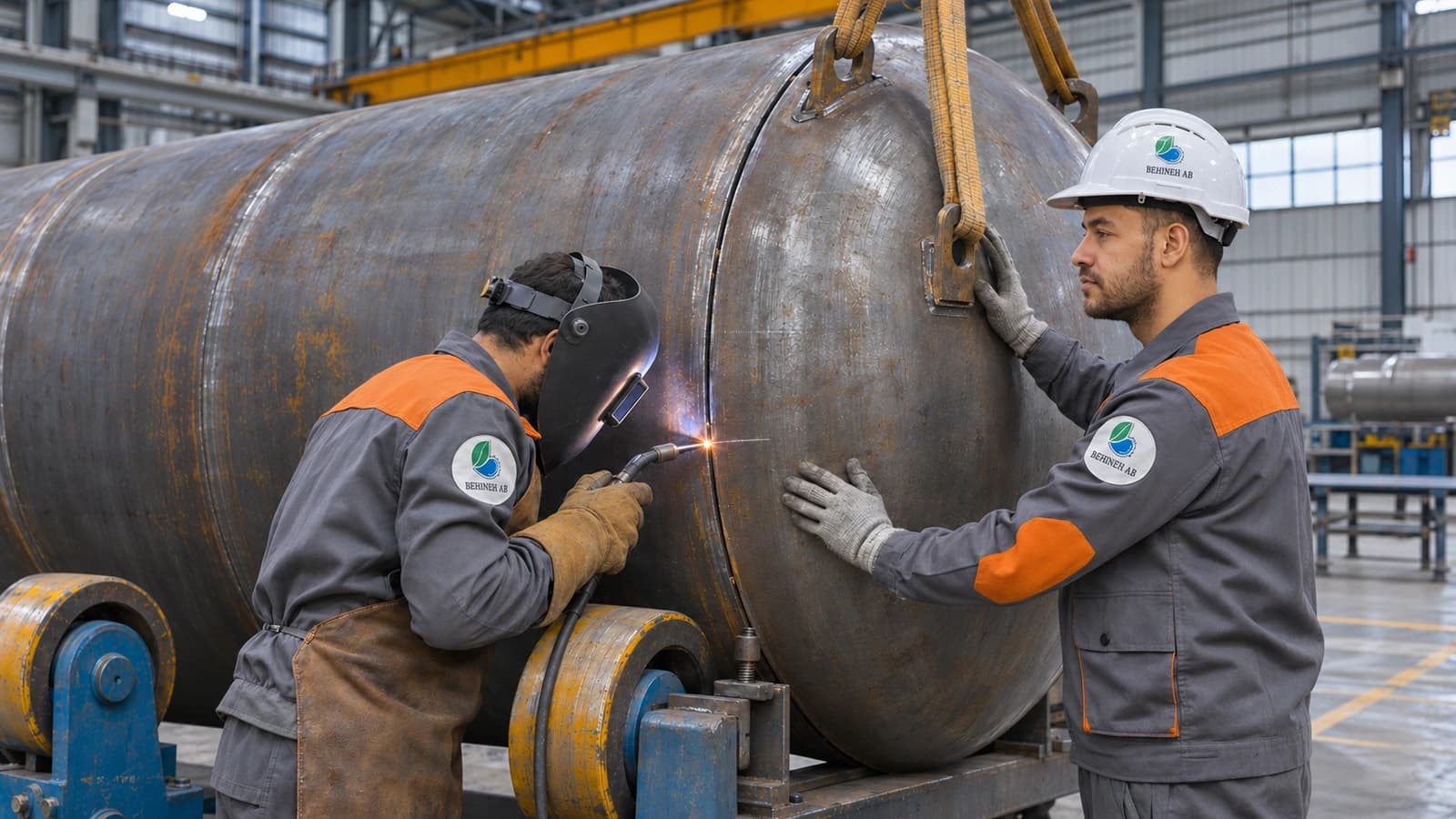
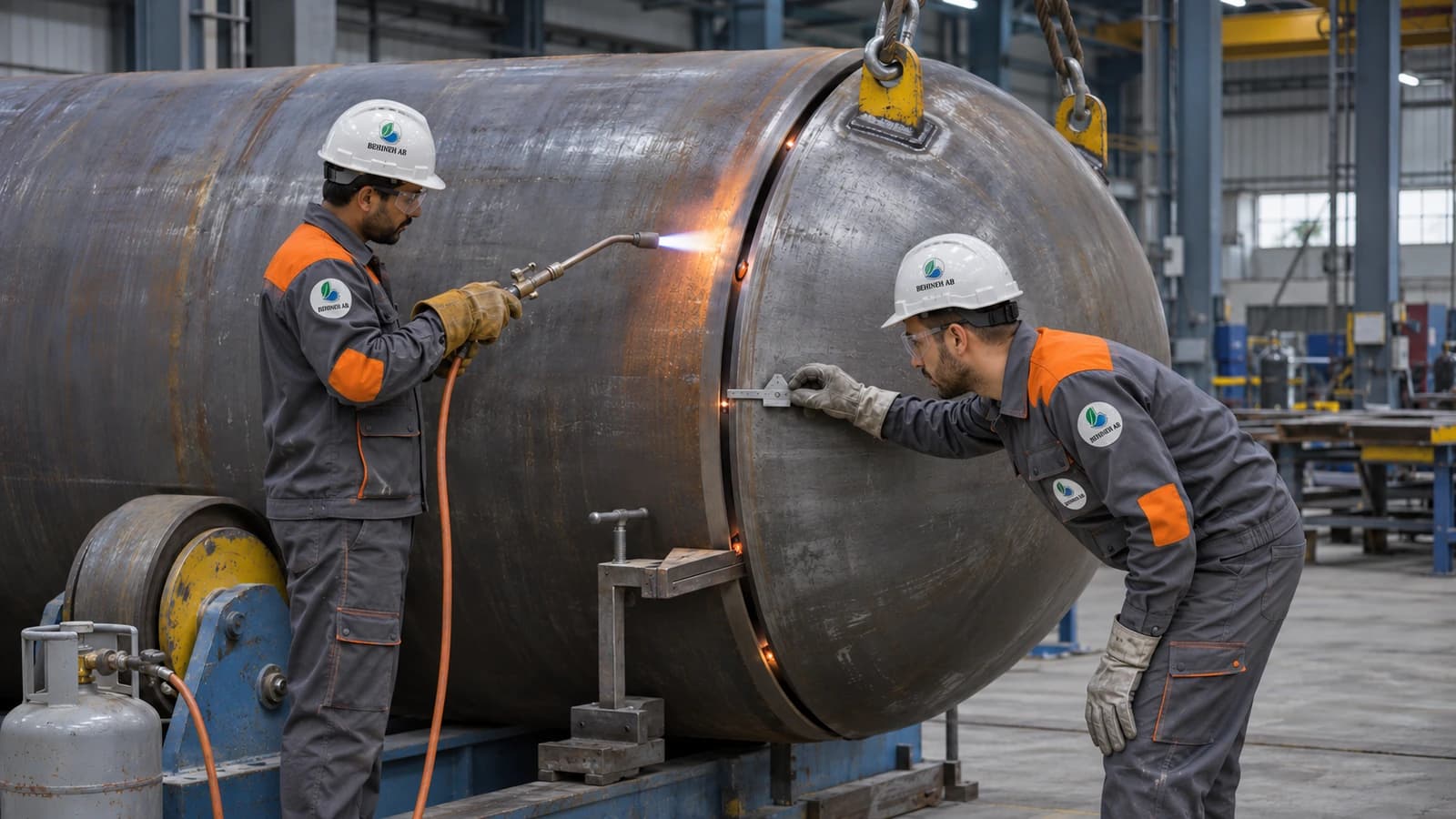
Building a water tank follows the same general route as any steel tank: cutting, rolling, assembling the courses, welding the bottom and roof and installing the nozzles. We describe this route in detail in the article on tank manufacturing steps. The particular point for a drinking water tank is that every internal weld must be smooth and free of pores, because the coating does not adhere well to an uneven weld and fails there first.
- Inlet at the top and outlet a little above the bottom so that sediment does not enter the supply pipe
- Overflow and bottom drain
- Manholes on the roof and shell
- Vent with a mesh to keep out insects and dust
- Level gauge and ladder
Internal coating of drinking water tanks
A steel drinking water tank needs an epoxy coating made for potable water, certified for contact with drinking water. Before painting, the surface must be completely clean and roughened. And the tank is not filled until the coating has fully cured; if it is filled earlier, the taste and smell of solvent get into the water.
Galvanised and stainless tanks have no internal coating. In galvanised tanks the zinc layer does the protecting, and in stainless tanks the chromium oxide layer.
Fill test and disinfection
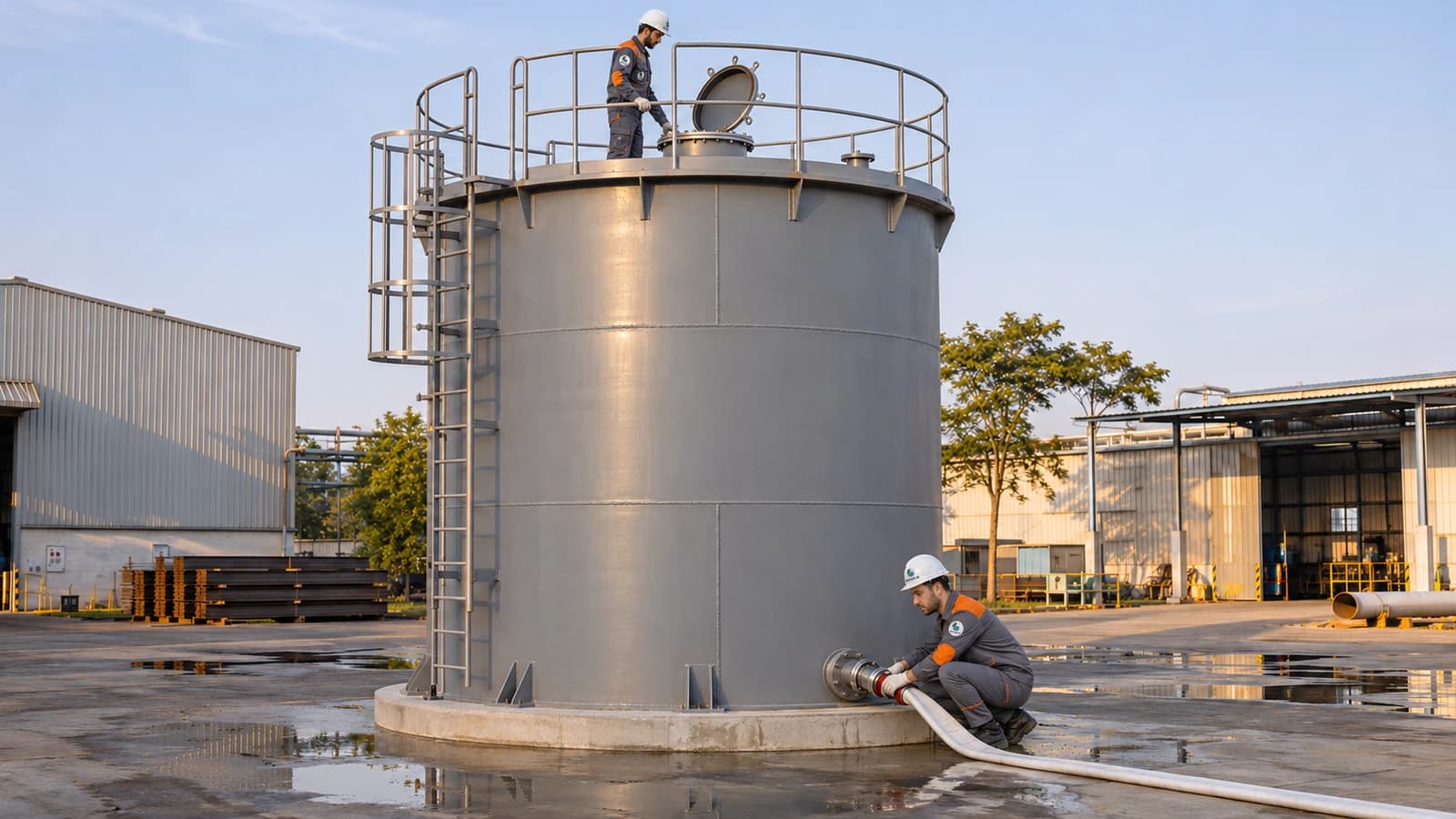
Before delivery, the tank is filled to the brim and usually left for twenty-four hours. All the welds, especially the bottom-to-shell weld, are inspected from outside. Any wet patch means a leak. This is the hydrostatic test for atmospheric tanks, which we carry out in our own factory.
After installation and before it is put into service, a drinking water tank is washed and disinfected with chlorine. This is usually the operator's job, but it must be included in the project schedule.
Small water tanks
For tanks under a few thousand litres, a stainless tank is often the more economical choice. Its plate is thin, it needs no paint and it requires almost no maintenance. At these sizes, the minimum fabrication thickness and the cost of accessories make up a larger share of the price than the volume itself.
Choose the material by the water's use, the shape by the installation space, and let the calculation decide the thickness. A tank that has passed the fill test in the factory gives the least trouble at the installation site.