A silo's capacity in tonnes comes from the volume of the cylinder and hopper times the material's bulk density. The formula, a density table for cement, wheat and PVC granules, and an example.
Silo volume
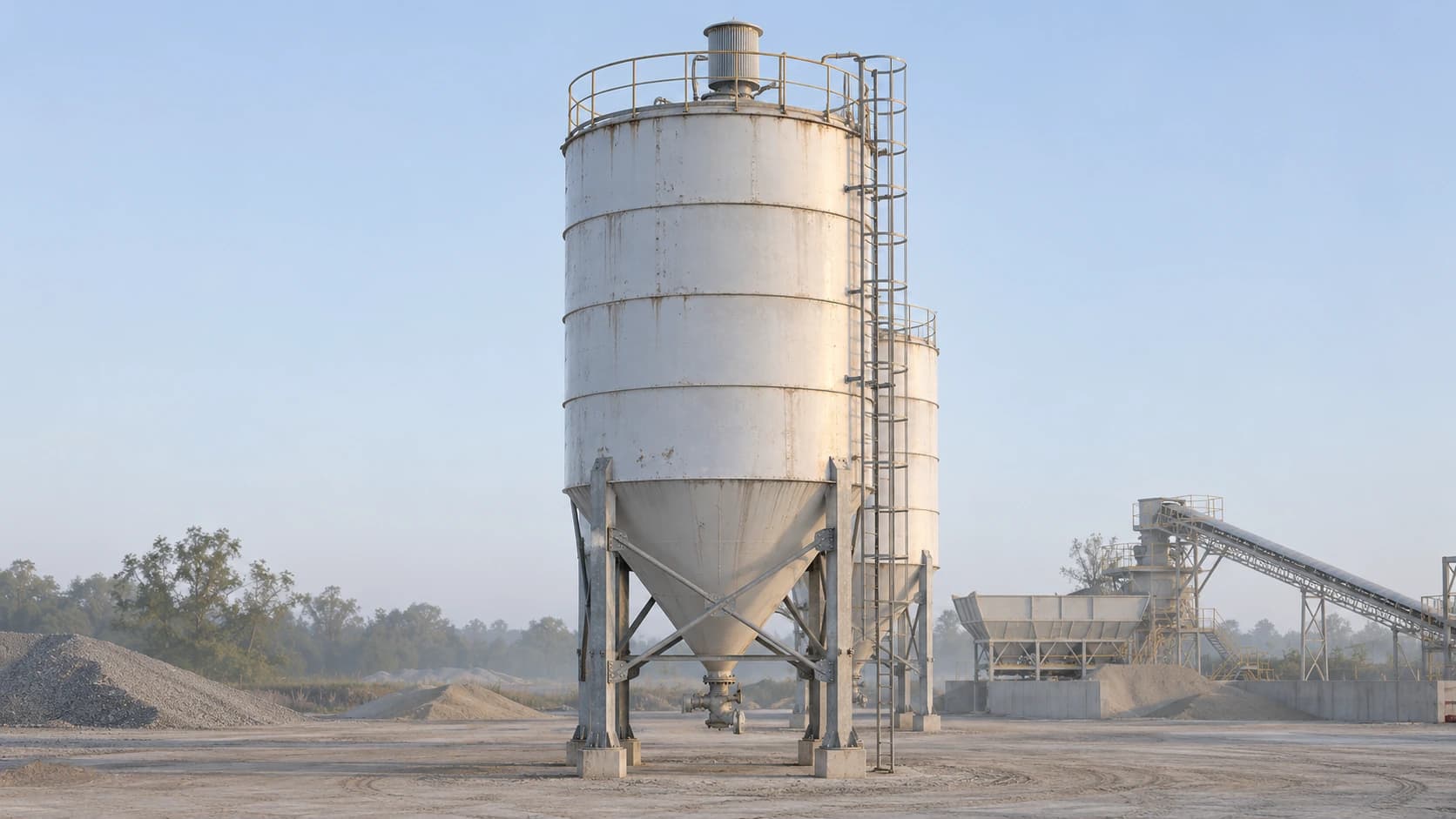
A silo's volume is the sum of two parts: the cylindrical body and the conical hopper. The body volume is π × R² × H. The hopper is a truncated cone whose volume is π × h × (R² + R × r + r²) / 3. Here R is the body radius, r the radius of the outlet and h the hopper height.
The hopper height is set by its angle: h = (R − r) × tan(hopper angle to the horizontal). A steeper hopper flows better, but it is taller and makes the silo taller.
From volume to tonnes: bulk density
A silo's capacity in tonnes equals the volume times the material's bulk density. Bulk density differs from the density of the material itself, because it also counts the empty space between particles. It depends on moisture, particle size and how compacted the material is. The figures below are approximate; for design, the actual value for the material must be obtained.
| Material | Approximate bulk density (t/m³) |
|---|---|
| Cement | 1.2 to 1.5 |
| Wheat | About 0.75 to 0.8 |
| Maize | About 0.72 |
| PVC granules | About 0.55 to 0.65 |
| Polyethylene granules | About 0.55 |
| Hydrated lime | About 0.4 to 0.6 |
| Dry sand | About 1.5 to 1.7 |
Example
- Body volume: π × 1.5² × 8 ≈ 56.5 m³
- Hopper height: (1.5 − 0.15) × tan 60 ≈ 2.34 m
- Hopper volume: π × 2.34 × (2.25 + 0.225 + 0.0225) / 3 ≈ 6.1 m³
- Total volume: about 62.7 m³
- With cement (1.4): about 88 tonnes. With wheat (0.78): about 49 tonnes. With PVC granules (0.6): about 38 tonnes
In practice a silo is never filled to the brim. At the top, the material forms a conical heap at its natural angle of repose and some space stays empty. That is why the real capacity is a little less than the figure above.
A silo of the same dimensions is twice as heavy with cement as with PVC granules, so its legs, body and foundation must also be designed for the heavier material. To calculate capacity, optimum dimensions, plate thickness and weight, use the online silo calculator, where you can select the material.
Silo capacity = (body volume + hopper volume) × bulk density. Specify the main material from the start, because both the capacity in tonnes and the structural design depend on it. See the steel silo fabrication page for design details and accessories.