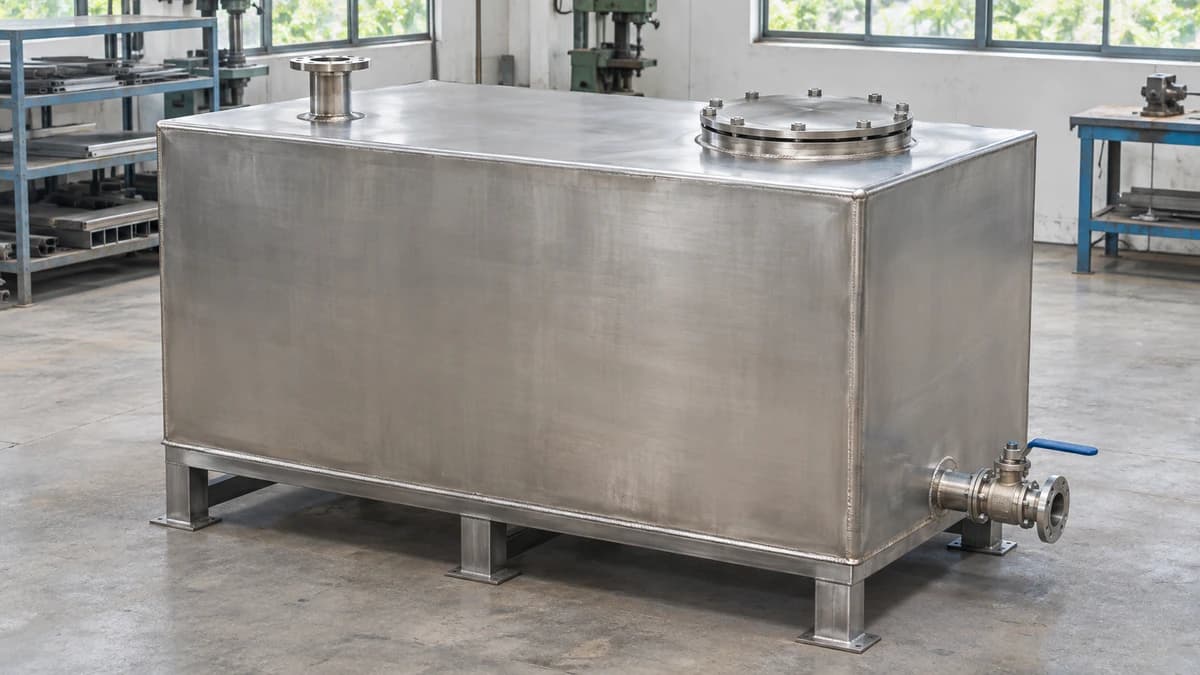
The volume of a rectangular tank is simple: length × width × height. But the working volume, the pressure on the walls and the stiffeners need their own calculation.
The volume formula
The volume of a rectangular tank equals the inside length times width times height. A tank measuring 3 by 2 by 2 m has a total volume of 12 m³, i.e. 12,000 litres. If the water only rises to 1.8 m, the working volume is 10.8 m³.
Water pressure on the walls
Water pressure rises from zero at the surface to its maximum at the bottom. At a height of 2 m, the bottom pressure is about 0.2 bar. That sounds small, but on a flat 6 m² wall the total force comes to several tonnes. A cylinder carries this pressure through tension in the plate. A flat plate has to carry it in bending, which is why it bulges.
That is why a rectangular tank cannot be built without stiffeners. Horizontal and vertical sections divide the wall into smaller panels. In larger tanks, tie rods tie opposite walls together. The plate thickness is calculated from the size of these panels and the water pressure.
Online calculation
The online rectangular tank calculator works out the wall plate thickness, the spacing and size of the stiffeners, the bottom beams, the roof and the weight. For larger volumes that need assembly on site, a panel galvanised tank is also a good option.
A rectangular tank's volume is simple; its strength is not. Per litre, a rectangular tank is heavier than a cylindrical one, but it fills the space completely.